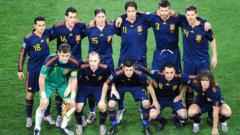
Spain's return to the FIFA World Cup final in 2026 exposes a profound transformation in how international football is played, controlled, and won. To compare Vicente del Bosque’s 2010 champions with Luis de la Fuente’s 2026 finalists is not a simple exercise in comparing eras. It is a study in how a national team systematically re-engineered its tactical blueprint. While the 2010 side treated ball retention as a defensive shield and an exhaustion mechanism, the 2026 iteration weaponizes possession, trading hypnotic, lateral sequences for explosive verticality, high-tempo transitions, and isolation-based wing play.
Understanding this shift requires moving past romanticized notions of "tiki-taka" and analyzing the underlying spatial mechanics, personnel optimizations, and structural cost functions that separate these two historic squads.
The Core Structural Paradigms: Control vs. Chaos
The tactical divergence between 2010 and 2026 is rooted in how each team values and exploits space. The two systems represent fundamentally different solutions to the problem of breaking down a low defensive block.
The 2010 Rest-Defence and Risk-Mitigation Loop
The 2010 squad operated within a highly rigid, risk-averse framework designed to minimize transitional chaos. With a midfield core of Sergio Busquets, Xabi Alonso, Xavi Hernández, and Andrés Iniesta, possession was maintained to control the tempo of the game and physically exhaust opponents.
[Defensive Line] ---> [Busquets / Alonso] ---> [Xavi / Iniesta] ---> [Patient Lateral Circulation]
This model relied on a slow, methodical build-up. Passes were short, horizontal, and highly dense within the middle third. This served as a structural insurance policy: by keeping the ball in tight, predictable zones, Spain maintained a flawless rest-defence (preventative positioning behind the ball). If possession was lost, the immediate proximity of players allowed for instant counter-pressing. The structural cost was a lack of directness; Spain often won matches by narrow 1-0 margins, suffocating opponents rather than blowing them open.
The 2026 Vertical Attack and Rest-Defense Stagger
Under Luis de la Fuente, possession is not an end in itself but a platform for rapid penetration. The 2026 side uses a staggered 4-1-2-3 or 3-2-5 structure in possession, actively seeking to split lines and create isolated 1v1 scenarios on the wings.
                [L. Yamal (1v1 Wing)]
                      ^
                      | (Line-Breaking Pass)
[Cubarsí / Laporte] ---> [Rodri / Ruiz (Staggered Midfield)] ---> [N. Williams (1v1 Wing)]
Instead of keeping the opposition block in front of them, Spain now coaxes the opponent to press high, using the press-resistance of Rodri and Pau Cubarsí to play through the lines. Once the first line of pressure is bypassed, the ball is immediately driven forward. The system trades absolute possession metrics for high-probability, high-velocity attacking sequences.
Positional Analysis: Systemic Upgrades and Trade-offs
Evaluating the player profiles across both eras reveals how modern physical demands have reshaped individual roles on the pitch.
Goalkeeper: Casillas' Instructive Reflexes vs. Simón's Deep Build-up
The difference in goal-line philosophy illustrates the tactical demands of modern football.
- Iker Casillas (2010): A traditional line-keeper of elite caliber. Casillas excelled in emergency defending—unbelievable reflexes, spatial sweep-up, and legendary one-on-one interventions. He was rarely integrated into the build-up phase; his primary job was to preserve clean sheets when the rest-defence failed.
- Unai Simón (2026): Serves as an active deep playmaker. Simón acts as the eleventh outfield player, comfortable inviting pressure, executing chipped passes over the pressing line, and dictating the angle of Spain's initial build-up. While he may not match Casillas' historic shot-stopping aura, his presence enables the high, aggressive positioning of the outfield unit.
Defense: Puyol-Piqué Rigidity vs. Cubarsí-Laporte Fluidity
In 2010, the defensive partnership of Carles Puyol and Gerard Piqué represented a perfect blend of physical dominance and anticipation. Puyol operated as a high-intensity stopper, while Piqué read the space behind him, sweeping up loose balls and distributing calmly.
In 2026, the inclusion of 19-year-old Pau Cubarsí alongside Aymeric Laporte brings a completely different dimension. Cubarsí represents the peak evolution of the ball-playing center-back. His passing range is vertical rather than lateral. He actively steps into midfield to deliver progressive, line-breaking passes directly to the forwards, allowing Spain to skip phase-two build-up entirely when defensive lines offer central gaps.
Midfield: The Monolithic Four vs. The Staggered Engine Room
The 2010 midfield is widely regarded as one of the most technically perfect units in football history, but its dominance came at a specific physical cost.
| Metric / Dimension | 2010 Midfield (Alonso, Busquets, Xavi, Iniesta) | 2026 Midfield (Rodri, Fabián Ruiz, Dani Olmo) |
|---|---|---|
| Tactical Role | Ball retention, control, rhythm manipulation | Line-breaking, vertical runs, pressing energy |
| Physical Profile | Low center of gravity, high agility, low top speed | High physical presence, intensive running, duel dominance |
| Spatial Focus | Middle third (generating endless passing triangles) | Half-spaces, box arrivals, defensive transitions |
| Direct Threat | Low direct goal threat; relied on forward movement | High direct threat via long-range shooting and box entry |
The 2026 midfield, anchored by Rodri, relies on dynamic positioning. Fabián Ruiz provides a vertical, box-to-box threat, using his physical presence to press heavily, recover possession, and score from distance. Dani Olmo operates as a highly mobile playmaker, drifting into half-spaces to receive on the half-turn and feed the wingers. This structure is faster, physically more imposing, and highly dangerous in transition, even if it lacks the absolute, hypnotic control of the 2010 group.
The Wing Revolution: Systemizing the 1v1 Threat
The defining tactical shift of Spain’s 2026 team is the deliberate isolation of its wingers, specifically Lamine Yamal.
In 2010, Spain often played without natural, wide wingers. David Silva or Andrés Iniesta would start wide but drift centrally to overload the midfield, leaving the width to overlapping full-backs. The attack was concentrated, looking to play intricate, short combinations through congested central zones.
The 2026 team uses the opposite principle: maximal width to stretch the opponent's defensive block.
- Tactical Isolation: By maintaining width on the touchlines, wingers like Lamine Yamal and Nico Williams force opposing full-backs to defend far wider than they would like. This prevents opposition defenses from remaining compact.
- The Decoy Effect: If opponents double-team Yamal on the right flank, it instantly opens up large gaps in the half-spaces for advanced midfielders (like Olmo) or the opposite winger to exploit.
- Transition Weaponization: The extreme pace and dribbling efficiency of these wingers transform Spain into a devastating counter-attacking unit. When possession is won deep, Spain no longer recycles. They launch direct vertical passes to exploit the space behind the opponent's high defensive line.
Tactical Summary: The Ultimate Comparison
To visualize how these systems compare mechanically, we can break down their primary operational phases:
- Build-up Phase: 2010 relied on slow, short passing sequences starting from deep midfield. 2026 utilizes direct vertical options, where center-backs or Unai Simón look to bypass the first press immediately.
- Attacking Phase: 2010 focused on central overloads, waiting patiently for defensive lapses. 2026 uses wide isolation, utilizing Lamine Yamal's dribbling threat to collapse defenses.
- Defensive Transition: 2010 executed an immediate, compact five-second counter-press designed to win the ball back high and keep the game slow. 2026 uses a coordinated mid-to-high block, relying on physically robust midfielders to absorb transitions and counter-attack at speed.
The Strategic Play: Which System Wins?
Determining which generation is superior requires choosing between two distinct tactical values: absolute risk minimization versus dynamic vertical efficiency.
If these two teams met on a pitch under modern officiating and physical standards, the tactical matchup would be a battle of structural friction. The 2010 team would almost certainly dominate possession, choking the supply lines to Spain's 2026 attack. However, the physical intensity of the modern press, combined with the raw transition speed of players like Lamine Yamal, would test the high defensive line of Puyol and Piqué in ways the slow, possession-dominated eras of 2010 never did.
Ultimately, Vicente del Bosque's 2010 squad represents a perfect peak of a singular, uncompromising football philosophy. Luis de la Fuente’s 2026 side, conversely, is a triumph of modern tactical flexibility—a team built to survive, adapt, and exploit the chaotic, high-intensity landscapes of modern tournament football.