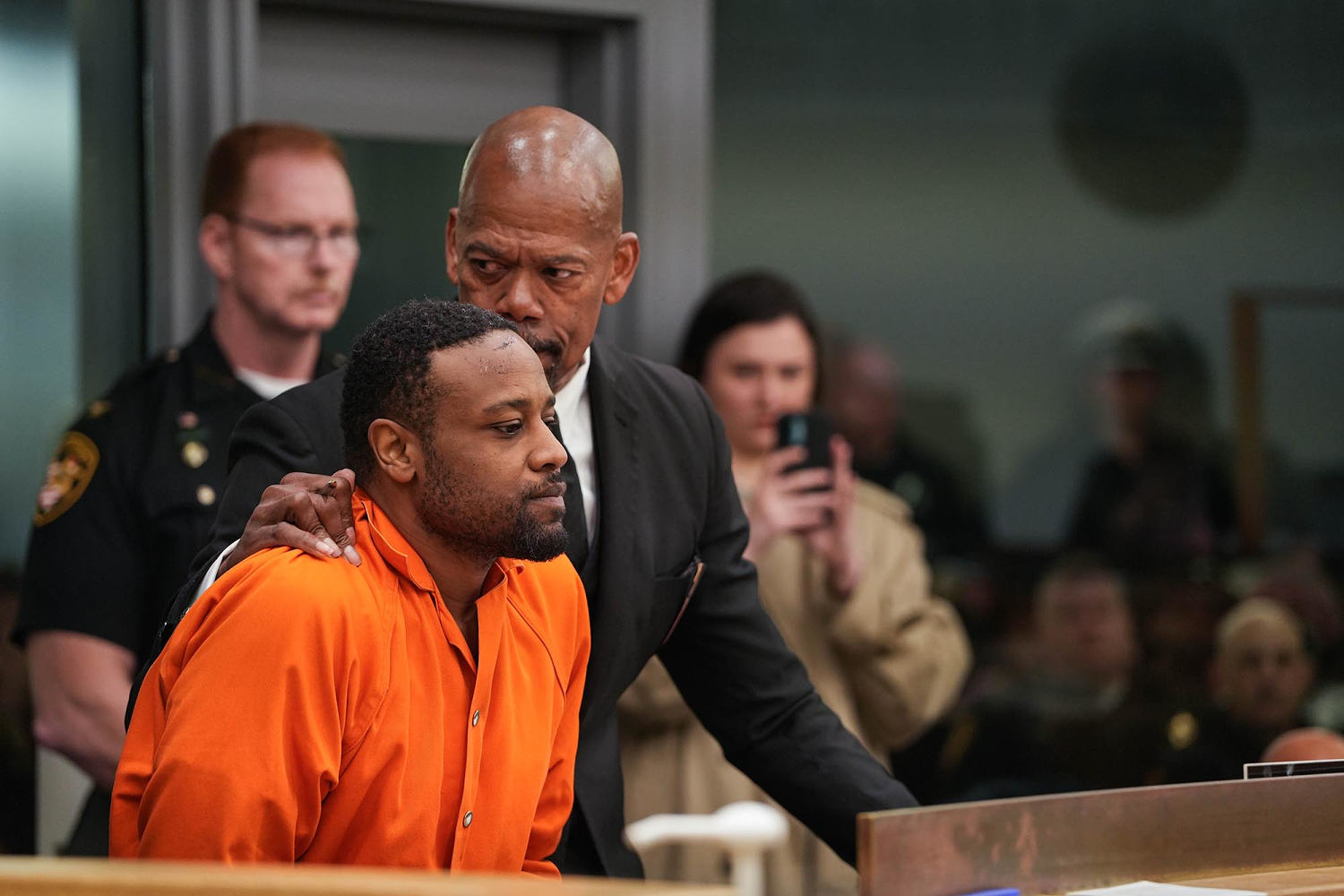
The arithmetic of institutional tragedy rarely balances in a courtroom, yet prosecutors and defense attorneys spent weeks attempting to tally an impossible ledger in a Hamilton County facility. When jury selection began for the trial of Rodney Hinton Jr.—accused of deliberately striking and killing a sheriff's deputy with his vehicle just hours after viewing body camera footage of his teenage son's fatal encounter with police—the proceedings laid bare a profound fracture in public trust. This was not merely a murder prosecution. It was an examination of what happens when the state's apparatus of lethal force intersects directly with raw, unmediated paternal despair.
To understand the trajectory of this case requires stepping back from the sterile environment of the judicial bench and looking at the sequence of May 2025 in Cincinnati. Eighteen-year-old Rodney Hinton Jr.—the defendant's namesake and son—had been shot and killed by law enforcement during a foot pursuit. For any family, losing a child is an irreversible catastrophe. For a marginalized family watching the machinery of an internal investigation grind forward, the immediate aftermath is defined by a vacuum of answers. Police departments protect their own procedural timelines, releasing body camera footage on their own terms. When the Hinton family finally sat down to watch those digital files, they were confronted with the final, violent moments of a young life extinguished by state authority.
What followed the screening was catastrophic kinetic action. Investigators alleged that Rodney Hinton Jr. (the father) weaponized his vehicle, targeting and striking retired Deputy Larry Henderson, who was working a special duty detail. Henderson succumbed to his injuries, creating a devastating mirror image of grief: another family mourning a public servant, another community fractured, and another life abruptly ended under the banner of law enforcement.
The defense team, led by seasoned litigators, faced an uphill battle from opening statements. They entered a plea of not guilty by reason of insanity, pointing to an acute psychological break triggered by the profound trauma of watching one's child killed on a screen. Psychiatry and criminal law often speak different languages. The law requires a neat categorization of intent, premeditation, and mens rea. Human neurology under
When Grief Meets the Machine of Justice The Trial Over a Fatal Collision and a Shattered Community
news, lifestyle
Jury selection commenced in a courtroom where the weight of an entire community's trauma hangs in the air. On trial is an Ohio father facing aggravated murder charges for allegedly using his car as a weapon against a deputy, an act born from a catastrophic collision point between personal loss and systemic breakdown. This case transcends a routine homicide docket. It serves as a grim examination of what happens when the state's use of lethal force shatters a family, leaving survivors to navigate a landscape where justice feels entirely out of reach.
The sequence of events leading to this courtroom began long before the fatal vehicle crash that took the life of a deputy. Months prior, the defendant's son died during a police intervention, a killing that cleaved the father's world in two. In the immediate aftermath, standard investigative loops spun forward, clearing the officers involved and leaving a grieving parent in an informational vacuum. For months, local advocates and family members argued that accountability was absent, creating a pressure cooker of unaddressed grief, institutional distrust, and profound psychological distress. When systemic channels fail to offer validation or redress, individuals sometimes crack under the strain of absolute powerlessness.
That pressure reportedly manifested on a dark stretch of road. Prosecutors argue that the father, consumed by vengeance, targeted a law enforcement vehicle and accelerated, turning a multi-ton machine into a lethal projectile. The collision claimed the life of a deputy who was entirely unconnected to the initial shooting of the defendant's son. In the eyes of the state, this is a calculated, premeditated act of terror against public servants. Defense teams, however, face the grueling task of unpacking the defendant's mental state, framing the incident not as cold-blooded murder, but as the catastrophic fracture of a mind unmoored by state-sanctioned violence against his child.
In American jurisprudence, grief is rarely considered an adequate defense for taking a life, and legally, the distinction between a calculated attack and a complete psychological collapse under trauma is razor-thin. Yet, criminal courts are increasingly forced to grapple with the psychological aftermath of fatal police encounters on surviving family members. When a citizen loses a child to state action and perceives an absolute wall of immunity protecting the perpetrators, the social contract fractures. The trial forces a public reckoning with the compounding tragedies that occur when accountability is missing from the first institutional failure, paving the way for the second.
As attorneys question potential jurors, the atmosphere is heavy with pre-trial motions regarding what evidence can be introduced. The defense wants the jury to understand the profound context of the son's death, arguing that the prior trauma is essential to explaining the defendant's state of mind. The prosecution insists that the prior incident is a smokescreen, an attempt to justify an indefensible act of violence against an innocent officer. Judge and counsel must walk a legal tightrope, balancing the narrative of a father's broken psyche against the strict statutory definitions of murder and depraved indifference.
Every community member sitting in the gallery recognizes the double tragedy etched into the docket. Two families are irreparably altered. One mourns a deputy killed in the line of duty, executing routine patrols without warning of the storm heading his way. The other mourns a young man lost to police bullets, followed by a father who allegedly traded his remaining freedom to strike back at the badge. There are no heroes in this courtroom, only the residual wreckage of systems that failed to protect, failed to investigate transparently, and ultimately failed to contain the blast radius of initial violence.
The trial will test the limits of empathy within the criminal justice framework. Jurors will be asked to separate raw human anguish from cold legal statutes, a demand that runs counter to basic human instinct. They will decide whether a broken man crossed the line into calculated murder or whether the state's initial failure helped forge the weapon that ended two lives. The verdict will reverberate far beyond the county lines, leaving a mark on how courts handle the catastrophic intersection of institutional grief, community rage, and the raw mechanics of retribution.