When the Chinese Communist Party’s Central Committee issued its November 7, 2026 directive promising "zero tolerance" for election meddling, vote-buying, and procedural misconduct ahead of the 21st Party Congress, state media framed it as a routine anti-corruption safeguard. That framing misses the point entirely. The directive—which launches an eight-month selection process running through June 2027 to choose 2,360 delegates from 38 electoral units—is not about Western-style ballot integrity. It is an elite disciplinary dragnet designed to eliminate informal patronage networks, enforce ideological conformity, and guarantee an uncontested leadership reshuffle when the Congress convenes in Beijing in the second half of 2027.
To understand why Beijing is deploying its heaviest political machinery nearly a year before the main event, you have to look at what a Party Congress delegate actually does. On paper, these 2,360 individuals represent the party’s rank and file, ratifying constitutional amendments and electing the 21st Central Committee. In practice, becoming a delegate is the single most lucrative credential in Chinese provincial politics. It signals proximity to Zhongnanhai, confers informal immunity from local rivals, and serves as the mandatory ticket for promotion into ministerial or provincial leadership. Whenever that kind of status goes up for grabs, local power brokers start cutting deals.
The Architecture of a Controlled Selection
Beijing does not leave delegate selection to chance, yet it insists on maintaining the mechanics of a multi-candidate vote. Under the Organization Department’s rules, the number of candidates placed on the ballot across the 38 electoral units must exceed the final 2,360 delegate seats by more than 15 percent.
That 15 percent margin is where the friction happens.
In a system where losing an internal party ballot is a public humiliation that can stall a cadre's career permanently, provincial officials face intense pressure to engineer outcomes before a single vote is cast. Historically, this has triggered frantic behind-the-scenes lobbying, illicit gift-giving, and regional bloc-voting—precisely the behaviors that led to the infamous Hunan and Liaoning vote-buying scandals over a decade ago, which shook the party’s upper ranks and forced Beijing to invalidate hundreds of legislative seats.
The November 2026 circular explicitly targets these exact vulnerabilities, warning against "canvassing for votes," bribery, and "interference" at every stage of the nomination and vetting pipeline. By invoking "zero tolerance" at the very start of the cycle, the Central Committee and the Central Commission for Discipline Inspection (CCDI) are putting provincial party secretaries on notice. Any local official caught trading favors to get their protégés onto the Beijing delegation will not merely lose the seat; they will face career-ending disciplinary probes.
Political Standards Over Administrative Competence
Read the fine print of the Central Committee’s guidelines, and a clear hierarchy emerges. The directive explicitly mandates putting "political standards first," requiring vetting teams to scrutinize every nominee's "political stance and awareness, as well as their capacity for political judgment, thinking and implementation".
In Beijing’s political lexicon, those phrases are not generic boilerplate. They are direct references to the "Two Upholds"—unconditional loyalty to Xi Jinping’s core status and the centralized authority of the Central Committee. Economic track records, technical expertise, and local popularity all take a back seat to ideological reliability.
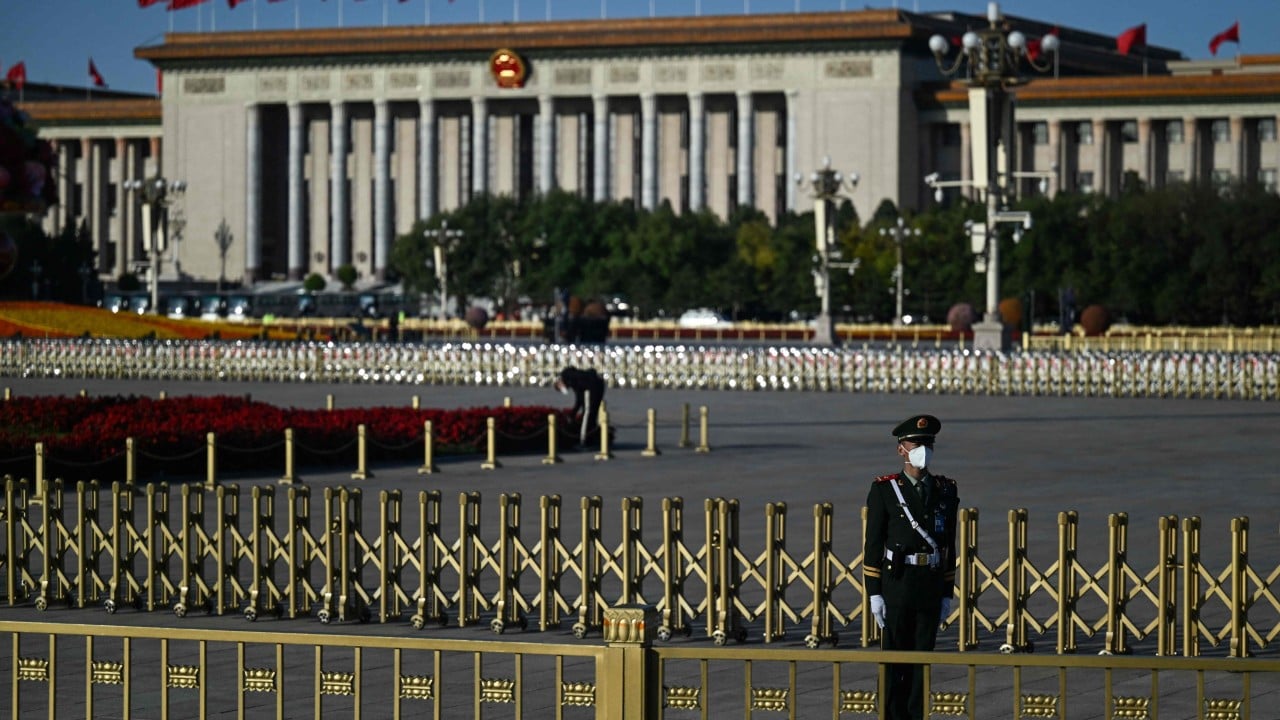
Even after an electoral unit casts its ballots, the process is far from over. Every elected delegate must pass through a central qualification review committee prior to the Congress. If a provincial faction manages to slip a compromised or politically suspect candidate past local screening, Beijing retains an absolute veto right up until the doors of the Great Hall of the People close.
Why the 2027 Stakes Are Unusually High
Every five-year Party Congress carries weight, but the 21st Congress arrives at a moment of acute structural stress for the Chinese leadership. The October 2026 fifth plenum communiqué described the upcoming gathering as occurring at a "critical stage" on the country's path toward its Second Centenary Goal of socialist modernization. Behind the triumphalist language lies a far more complicated reality.
China’s leadership is preparing for what analysts expect to be a major generational turnover on the Central Committee and Politburo. As senior figures from the 20th Central Committee approach retirement thresholds—or fall out of favor amid ongoing purges in the defense, finance, and technology sectors—dozens of high-level seats are opening up. At the same time, Beijing is managing a sluggish domestic recovery, mounting local government debt, and an unpredictable geopolitical environment following the 2026 U.S. midterm elections.
When economic growth slows, patronage shrinks. When patronage shrinks, elite competition turns vicious.
A veteran observer of Chinese elite politics recognizes this dynamic immediately. During boom years, rival factions could share the spoils of rapid expansion. Today, with fiscal resources tightening and regulatory scrutiny intensifying across state-owned enterprises and private tech firms alike, access to the central power structure is a zero-sum game. The "zero tolerance" mandate is a preemptive strike against the inevitable horse-trading that occurs when ambitious officials fight over a smaller pie.
The Push for "New Employment Groups"
One of the most telling details in the November 2026 rollout is who Beijing wants to see on the floor of the Great Hall of the People. Alongside traditional quotas for frontline workers, farmers, women, and ethnic minorities, the new guidelines specifically instruct electoral units to nominate delegates from "new forms of employment".
This category encompasses the tens of millions of gig economy workers—delivery riders, ride-hailing drivers, e-commerce livestreamers, and independent logistics contractors—who now form the backbone of urban service economies in China.
On the surface, bringing gig workers into the 21st Party Congress projects an image of grassroots responsiveness and modern inclusivity. Beneath the optics, however, lies a hard-nosed governance calculation. Gig workers are atomized, algorithmically managed, and historically difficult for traditional workplace party branches to organize. Over the past several years, labor disputes and localized strikes among delivery drivers and truckers have emerged as a persistent flashpoint for social stability.
By hand-picking vetted representatives from these sectors and elevating them to the party’s highest deliberative body, Beijing achieves two objectives simultaneously. First, it signals to a restless demographic that their interests are recognized at the top. Second, it co-opts influential figures within those networks into the formal state apparatus, extending party supervision directly into the digital labor market.
The Gray Area of "Zero Tolerance"
Here is the catch that state media commentary will never acknowledge. While the Central Committee’s directive demands strict adherence to democratic procedures and bans electoral manipulation, the very nature of the vetting system creates an inherent contradiction.
Local party committees are simultaneously instructed to guarantee that voters exercise their democratic rights freely and to ensure that only candidates who meet strict political, demographic, and sectoral quotas actually win. In practice, provincial Organization Departments resolve this tension by tightly curating the candidate pool long before any rank-and-file party member sees a ballot.
This creates a subtle form of institutionalized "meddling" that is not only tolerated, but required. If a local party secretary allows an genuinely spontaneous, unvetted grassroots candidate to upset an officially endorsed nominee—even in a clean vote—that secretary has failed their primary political task. Conversely, if they intervene too clumsily to block a rival and trigger a whistleblower complaint to the CCDI, they risk being prosecuted under the very "zero tolerance" rules they were supposed to enforce.
For provincial officials, navigating the next seven months is like walking a tightrope in a crosswind. They must deliver unanimous-looking enthusiasm and clean procedural paperwork without leaving fingerprints on the outcome.
What to Watch Between Now and June 2027
The delegate selection window stays open until the end of June 2027, giving Beijing plenty of time to turn the screws on local administrations. Watch three specific indicators over the coming months to gauge how smoothly—or roughly—this consolidation is actually proceeding.
First, track the pace of CCDI announcements targeting mid-level Organization Department officials and municipal party secretaries. If Beijing uncovers active vote-buying rings or factional resistance in key provinces like Guangdong, Jiangsu, or Sichuan, the disciplinary watchdog will make public examples of the offenders well before the June deadline to deter others.
Second, pay close attention to where senior central leaders choose to stand for election. By tradition, members of the Politburo Standing Committee are nominated and elected through specific provincial or sectoral electoral units—Xi Jinping, for instance, was elected through Guangxi ahead of the 20th Congress. Where rising stars are placed on the ballot in early 2027 will offer the earliest concrete clues about who is slated for promotion to the Politburo next autumn.
Third, watch the final delegate roster released next summer for unexplained omissions. Every five years, a handful of high-profile officials quietly fail to appear on the approved delegate list despite holding senior posts, signaling that they have failed the qualification review committee's vetting—and that their formal downfall is only a matter of time.