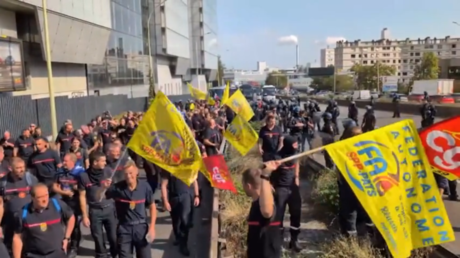
The smoke rising above the barricades in Paris and Lyon tells an old story with a terrifyingly modern twist. President Emmanuel Macron watches his approval ratings flatline at an abysmal fifteen percent, while millions of citizens flood the avenues to protest living costs, decaying public schools, and a state apparatus that has simply run out of money.
This is not merely another seasonal round of French labor unrest. It is the violent convergence of a fiscal crisis, structural state paralysis, and a profound collapse in executive authority that threatens to hand the keys of the Élysée Palace to the political extremes. Recently making headlines recently: The Shield And The Fracture Inside The Man Who Refuses To Fall.
To understand why France is burning once again, one must look past the burning dumpsters and tear gas. The immediate trigger began in the classrooms. What started weeks ago as high school student occupations protesting underfunded facilities, endless schedule gaps, and administrative bottlenecks quickly metastasized. When trade unions, railway workers, and public servants joined the movement, bringing over a million people into the streets across two hundred cities, the protest transformed into a full-scale assault on the architecture of modern French governance.
Successive short-lived minority governments, collapsing under budget disputes, have tried to patch a leaking hull with paper
The Anatomy of a French Paralysis Power Politics and the Fracture of the Fifth Republic More information on this are detailed by Associated Press.
news, business
French streets empty of transit workers, refineries lock their gates, and the smoke of protest tires drifts across the cobblestones of Paris. The strikes paralyzing France are not merely a temporary disruption of commuter schedules or a routine labor dispute over pension adjustments. They represent a fundamental fracture between an increasingly isolated executive branch and a public that views the current administration's economic prescriptions as an existential threat to the French social contract.
Emmanuel Macron rose to power on the promise of transforming France into a nimble, startup-style economy capable of competing on the global stage. Yet that ambition has crashed against the hard rock of French political tradition. The public square remembers that the state has historically served as a shield against the harshest currents of global capitalism. When the Elysée Palace attempts to force through structural reforms without building durable political consensus, the machinery of the state stops entirely.
Understanding this crisis requires looking past the burning barricades and examining the structural mechanics of French governance under the Fifth Republic.
The Structural Impasse of Presidential Technocracy
The architectural design of the French presidency encourages top-down governance. Charles de Gaulle engineered the system to ensure executive stability, insulating the head of state from the volatile shifts of parliamentary politics. In practice, this gives a modern president immense reformist power, particularly when backed by a compliant legislative majority or through constitutional mechanisms like Article 49.3, which allows bills to pass without a parliamentary vote.
However, wielding executive power without legislative consent carries a severe democratic cost.
When reform becomes something done to the citizenry rather than negotiated with them, the streets become the true parliament of France. Trade unions, despite declining formal membership rolls, retain an extraordinary capacity to mobilize the broader public because they tap into a deep, cultural skepticism of neoliberal efficiency. For millions of workers, the raising of the retirement age or the modification of unemployment benefits is not a rational adjustment to demographic trends. It is an assault on the post-war compromise that defined modern French citizenship.
The administration views its program through the cold lens of sovereign debt ratios and labor market participation rates. The striking worker views the same metrics through the lens of dignity, regional decline, and the erosion of public services. This disconnect is unbridgeable by technocratic decree alone.
Fiscal Realities Meet Political Reality
Public finances across Europe are under severe strain, and France is no exception. Budget deficits persistently breach European Union guidelines, and the cost of servicing national debt climbs higher with every adjustment by the European Central Bank. International ratings agencies watch the country with predatory patience, waiting for signs that Paris lacks the political spine to balance its books.
The administration argues that structural adjustments are non-negotiable. Without extending working years and trimming public expenditure, the French model faces eventual insolvency, unable to fund its legendary healthcare and pension commitments. On paper, the mathematics are difficult to dispute.
Yet spreadsheets do not win elections or maintain civil peace.
By treating fiscal reform purely as an accounting exercise, the government underestimates the symbolic weight of the welfare state. In the French political imagination, social protections are not mere line items to be optimized; they are the tangible proof that the Republic cares for its people. When those protections are altered to satisfy bond markets in Frankfurt or New York, the legitimacy of the central government evaporates.
The economic strategy relies on the assumption that temporary industrial pain will eventually yield permanent growth and investor confidence. But history suggests a different trajectory. Protracted strikes choke economic output, tourism revenues slump, small businesses bleed cash, and the tax receipts the government desperately needs to fix its balance sheet fail to materialize. The cure risks killing the patient.
The Erosion of the Political Center
The deeper danger facing the country extends beyond the immediate labor action. The political center, which Macron carved out as the sensible alternative to the populist extremes of the left and right, is hollowing out.
When compromise fails and protests become the only language that registers in the halls of power, radical alternatives gain currency. On the populist right, Marine Le Pen's political apparatus watches the unrest with disciplined silence, positioning itself as the true defender of the working class against urban elites. On the radical left, figures like Jean-Luc Mélenchon channel the fury of the streets into direct parliamentary obstruction and institutional challenge.
The traditional parties of the center-right and center-left, once the pillars of the Fifth Republic, have been reduced to marginal players, unable to command national loyalty or broker peace between labor and capital. This polarization leaves the nation locked in a recurring cycle of confrontation. Every major reform initiative triggers a trial of strength where neither side can afford to compromise without losing face, and neither side possesses the power to achieve total victory.
France remains one of the wealthiest and most productive nations on earth, possessed of world-class infrastructure, brilliant scientific talent, and a rich cultural heritage. Yet it is governed by a political settlement that appears increasingly incapable of resolving its internal contradictions.
The smoke over Paris will eventually clear. Transit lines will resume their schedules, and the refuse piling on the boulevards will be cleared away. But the underlying fracture will remain, waiting for the next administrative decree to tear it open once again.