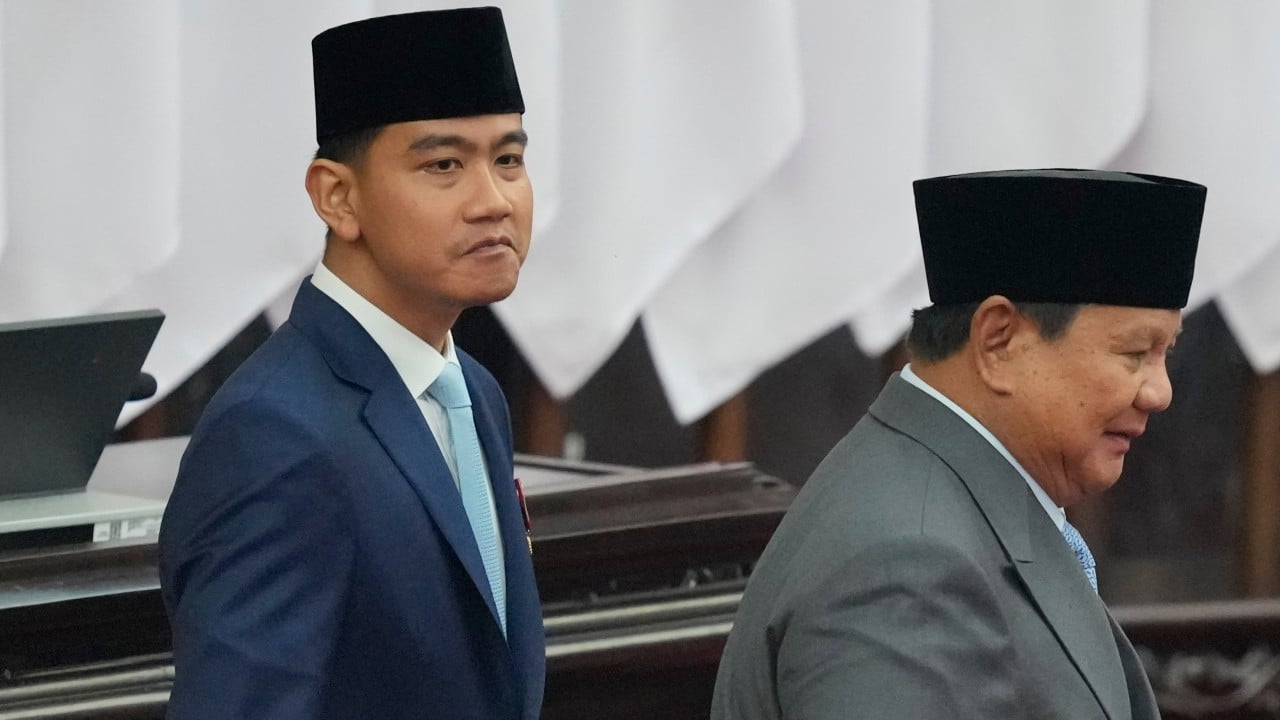
Indonesian Vice President Gibran Rakabuming Raka faces a mounting political threat as lawmakers in Jakarta weigh an official parliamentary inquiry into his eligibility, conduct, and family influence. While the administration of President Prabowo Subianto publicly projects unity, behind closed doors, factions within the House of Representatives (DPR) are calculating whether launching a formal probe serves their long-term leverage. The outcome will not just decide Gibran’s political survival. It will test the durability of Indonesia’s post-2024 ruling coalition and determine whether the nation’s democratic guardrails still hold against dynastic consolidation.
To understand why Gibran is suddenly vulnerable, you have to look past the surface-level headlines and examine the transactional mechanics of Indonesian politics. Coalitions in Jakarta are rarely built on shared ideology; they are constructed through the careful distribution of cabinet seats, state-owned enterprise board positions, and regulatory authority. When a young vice president arrives in office without a traditional party base of his own, he survives entirely on the goodwill of the political titans who brokered his rise. Right now, that goodwill is wearing dangerously thin. For a different view, consider: this related article.
The Anatomy of a Parliamentary Probe
In Indonesia, a parliamentary inquiry is far more than a routine legislative hearing. Known constitutionally as hak angket, the right of inquiry grants the DPR sweeping powers to summon witnesses, demand state documents, and investigate government policies or executive conduct suspected of violating the law. Historically, the mere threat of invoking hak angket has been enough to force cabinet reshuffles or extract major budget concessions from the executive branch.
For Gibran, the whispers of a probe center on two distinct vulnerabilities. The first is the lingering constitutional stain of how he reached the ballot in the first place. His candidacy only became possible after the Constitutional Court—then led by his uncle, Chief Justice Anwar Usman—issued a controversial ruling altering age requirements for presidential and vice-presidential hopefuls. Though Usman was later demoted for severe ethical violations by the court's own ethics panel, the political fallout never truly evaporated. Similar reporting on this trend has been published by NPR.
The second vulnerability is far more immediate and operational. Critics and rival party insiders point to controversies surrounding Gibran's past public communications, alleged administrative overreach during his tenure as Mayor of Solo, and questions over whether state resources were improperly deployed to bolster his national profile. A formal parliamentary inquiry would drag these grievances out of social media echo chambers and place them under the glaring lights of televised legislative hearings.
The Constitutional Hurdle of Impeachment
Even if lawmakers successfully initiate a probe, removing a sitting vice president in Indonesia is an arduous constitutional gauntlet. The framers of the post-Suharto reforms deliberately designed the impeachment process to prevent the kind of rapid, chaotic legislative coups that toppled President Abdurrahman Wahid in 2001.
To unseat Gibran, the DPR would first need to pass a formal opinion stating that he has violated the law—specifically through treason, corruption, bribery, other high crimes, or disgraceful conduct—or that he no longer meets the constitutional requirements to hold office. That vote requires a quorum of at least two-thirds of the legislature, with two-thirds of those present voting in favor.
If the DPR clears that bar, the case does not go straight to a removal vote. Instead, it is handed to the Constitutional Court, which has 90 days to examine, adjudicate, and rule on the parliament's legal opinion. Only if the court validates the DPR's findings does the matter move to the People’s Consultative Assembly (MPR) for a final impeachment vote.
Lawmakers know this math. They understand that an actual removal is a long shot unless the ruling coalition completely fractures. Yet in Jakarta, you do not need to finish an impeachment to destroy a politician's authority. The process itself is the punishment.
The Shifting Sands of Prabowo’s Mega-Coalition
President Prabowo Subianto entered office backed by the Onward Indonesia Coalition (KIM), an expansive alliance that quickly grew even larger as former rivals sought accommodation inside the tent. On paper, this supermajority makes the executive branch untouchable. In practice, bloated coalitions are notoriously unstable because there are never enough spoils to satisfy every patron.
Gibran occupies an awkward structural position within this architecture. He does not lead a major political party. His father, former President Joko "Jokowi" Widodo, spent a decade building a vast network of loyalists across the bureaucracy, police, and business sectors, yet Jokowi himself exited the presidency without formal control of a party apparatus after his bitter split with the Indonesian Democratic Party of Struggle (PDIP).
Without a party shield, Gibran is essentially a political freelancer operating at the highest level of government. When party bosses in the DPR evaluate their strategic options for the 2029 election cycle, they see Gibran not as a permanent fixture, but as a rival whose early elevation blocked their own ambitions. Several senior party leaders sacrificed their own vice-presidential aspirations in 2024 to accommodate the Jokowi-Prabowo alliance. Allowing Gibran to spend five years accumulating executive experience and state patronage threatens their future viability.
By floating the possibility of a parliamentary probe, party elites send an unmistakable message to the presidential palace. They are reminding both Prabowo and Jokowi that legislative support is rented, never owned.
The PDIP Factor and Opposition Calculus
While internal coalition friction provides the fuel, the Indonesian Democratic Party of Struggle (PDIP) holds the match. As the largest single party in the DPR and the former political home of the Widodo family, PDIP views Gibran’s rise as an act of profound betrayal. The party’s leadership has spent months methodically documenting institutional abuses from the 2024 election cycle, waiting for the optimal political moment to strike.
PDIP cannot launch a successful hak angket on its own. It needs defectors from within Prabowo’s own coalition to reach the necessary thresholds. Therefore, PDIP strategists are actively courting disgruntled factions within the Golkar Party, the National Awakening Party (PKB), and the NasDem Party.
To understand how this plays out, consider a hypothetical example of legislative horse-trading in Jakarta. Suppose a mid-sized coalition party feels shortchanged during negotiations over key ministerial portfolios or regional infrastructure budgets. Rather than publicly breaking with the president, its legislative leaders quietly signal to opposition counterparts that they might support an inquiry into the vice president's office. Suddenly, the palace is forced to negotiate on two fronts—placating its own allies while fending off opposition attacks.
This dynamic places President Prabowo in a delicate bind. He owes a massive political debt to Jokowi, whose late-stage endorsement and grassroots mobilization proved decisive in the presidential race. Abandoning Gibran early in the term would brand Prabowo as an unreliable partner and risk alienating Jokowi’s residual network within the security forces and civil service. Conversely, expending too much political capital to shield an unpopular vice president could paralyze Prabowo’s own ambitious legislative agenda, including flagship economic and defense programs.
Dynasty Politics Meets Public Fatigue
Beyond the elite maneuvering inside the parliament building in Senayan, there is a broader societal shift underway. For years, Jokowi’s soaring approval ratings insulated his family from widespread public backlash. Ordinary voters largely forgave the ethical shortcuts taken during his second term because they credited him with tangible infrastructure development, social welfare cash transfers, and steady macroeconomic growth.
Gibran does not enjoy that same reservoir of public trust. While he cultivated a tech-savvy, youthful image during his campaign, his limited legislative and executive track record has left him vulnerable to criticism whenever policy missteps occur. Furthermore, a growing segment of Indonesia’s urban middle class, student movements, and civil society organizations has grown deeply cynical about dynastic politics.
In a country that fought bitterly in 1998 to overthrow three decades of authoritarian family rule under Suharto, the sight of a sitting president bending institutional rules to install his eldest son as vice president struck a raw nerve. Academic protests, sharp editorial criticism from legacy media outlets, and viral social media campaigns have steadily chipped away at the aura of inevitability that once surrounded Gibran.
Lawmakers in the DPR are acutely sensitive to public sentiment. They rarely initiate a high-stakes confrontation with the executive branch unless they believe the public will applaud—or at least tolerate—the disruption. As skepticism toward Gibran’s qualifications hardens among key voter demographics, legislators see diminishing political risk in questioning his fitness for office.
What Happens to Governance During a Probe
If the DPR formally moves forward with a probe, the immediate casualty will be administrative focus. Indonesian ministries are notoriously risk-averse when legislative investigations are underway. Bureaucrats freeze decision-making, delay procurement contracts, and avoid signing off on major policy initiatives out of fear of being subpoenaed to testify before hostile parliamentary committees.
For an administration trying to accelerate GDP growth, attract foreign direct investment, and manage complex fiscal commitments, a prolonged political standoff is toxic. International investors watching Southeast Asia's largest economy look closely at executive stability. A vice president bogged down in constitutional and ethical inquiries signals institutional fragility, raising risk premiums and complicating sovereign debt management.
Moreover, a probe would inevitably widen the fault lines within the security and intelligence apparatus. During Jokowi’s decade in power, key appointments in the Indonesian National Police (Polri) and the military (TNI) were carefully calibrated to ensure loyalty. Under Prabowo, a former army general with his own deep institutional ties, those loyalties are gradually realigning. A parliamentary investigation into Gibran would force senior officials to choose between protecting the legacy of the previous administration and aligning fully with the new commander-in-chief.
The Leverage Game in Jakarta
Experienced observers of Indonesian politics know that dramatic legislative threats often end not with a bang, but with a quiet, backroom settlement. The history of the Reformasi era is littered with fiery parliamentary inquiries that mysteriously lost momentum once specific ministerial demands were met or lucrative state contracts were redistributed.
Gibran’s defenders are banking on this transactional reality. They calculate that once party leaders extract sufficient concessions from Prabowo’s inner circle, the appetite for a constitutional crisis will evaporate. In this scenario, the threat of a probe serves merely as a pricing mechanism—a way for coalition partners to establish the true cost of their continued loyalty.
Yet there is a crucial difference this time around. Unlike previous battles over fuel subsidies or tax policy, the controversy surrounding Gibran touches directly on the legitimacy of the presidency’s succession architecture. If Prabowo is incapacitated or unable to finish his term, Gibran becomes president of the world’s fourth most populous nation. That constitutional reality raises the stakes far above routine budget negotiations.
Party bosses know that allowing Gibran to consolidate power unchallenged makes him the automatic frontrunner for the 2029 presidential race, armed with the full weight of incumbency. For ambitious leaders across Golkar, PDIP, and other major parties, stopping that trajectory now is an existential priority. Whether through a formal hak angket, a targeted ethics investigation, or a systematic stripping of his executive responsibilities within the cabinet, the campaign to contain Gibran has already begun.
Gibran Rakabuming Raka entered the vice-presidential palace as the ultimate symbol of his father’s political dominance, untouchable and seemingly destined to shape Indonesian politics for a generation. Today, he stands isolated in a shark tank of seasoned party operators who no longer fear his last name.