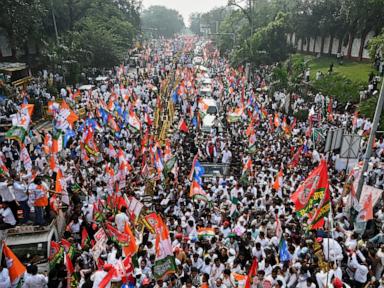
When opposition parties in India mobilize against the Chief Election Commissioner, the event is rarely an isolated dispute over administrative logistics. It represents a recurring structural stress test on the constitutional separation of powers, driven by asymmetries in institutional appointment mechanisms, perceived enforcement disparities, and the political utility of pre-election delegitimization. Standard political reporting treats these protests as episodic theater—cataloging slogans, police detentions, and reciprocal press briefings. That surface-level framing misses the underlying operational mechanics: how an electoral management body maintains credibility when the legal rules governing its leadership selection shift in favor of the incumbent executive.
To understand why these demonstrations recur with predictable regularity ahead of state and national ballot cycles, analysts must separate the immediate triggers from the structural vulnerabilities embedded in the Election Commission of India (ECI).
The Structural Anatomy of the Dispute
The ECI derives its authority from Article 324 of the Indian Constitution, which vests the superintendence, direction, and control of elections in a three-member body consisting of the Chief Election Commissioner (CEC) and two Election Commissioners (ECs). For decades, the legitimacy of this body rested on institutional convention rather than statutory insulation. That equilibrium fractured following the legislative passage of the Chief Election Commissioner and Other Election Commissioners (Appointment, Conditions of Service and Term of Office) Act, 2023.
Prior to this legislation, a March 2023 Supreme Court ruling had temporarily mandated a three-member selection committee comprising the Prime Minister, the Leader of the Opposition, and the Chief Justice of India. The subsequent statute replaced the Chief Justice with a Union Cabinet Minister nominated by the Prime Minister. This single statutory modification altered the game theory of electoral oversight:
- Executive Majority Lock-in: By giving the ruling party a built-in two-to-one voting majority on the selection panel, the appointment mechanism transitioned from a consensus-seeking model to an executive-determined model.
- Asymmetric Tenure Security: Under Article 324(5), the CEC can only be removed through a parliamentary impeachment process identical to that of a Supreme Court judge. In contrast, the two other Election Commissioners can be removed by the President on the recommendation of the CEC. This creates an internal hierarchy where junior commissioners face distinct career incentives compared to the chief.
- The Perception Deficit: In institutional economics, regulatory bodies rely on ex-ante credibility—the belief among all market or political participants that the referee operates independently of the players. Once the selection mechanism allows one player to unilaterally appoint the referee, every subsequent operational decision by the referee is interpreted through the lens of principal-agent bias, regardless of the actual merit of the ruling.
The Three Pillars of Opposition Grievance
Opposition coalitions do not stage street protests or parliamentary walkouts simply because an election schedule is announced. Their mobilization follows a specific diagnostic framework targeting three operational friction points within the ECI's jurisdiction.
1. Enforcement Asymmetry Under the Model Code of Conduct
The Model Code of Conduct (MCC) is a set of consensus-driven guidelines that take effect the moment election dates are announced. It lacks statutory backing, relying entirely on the ECI's moral authority and administrative powers (such as transferring officials or barring candidates from campaigning for fixed durations) for enforcement.
Opposition parties consistently allege a dual-track enforcement regime. When complaints are filed against opposition figures for rhetorical violations or misuse of state machinery, notices are issued rapidly. When parallel complaints are lodged against senior figures of the ruling party—particularly concerning religious polarization in campaign speeches or the use of government infrastructure—processing times lengthen, or notices are addressed to party presidents rather than the individual speakers. From a systems perspective, inconsistent latency in enforcement destroys deterrence. If the expected penalty for a rule violation approaches zero for one cohort of actors, rational campaign managers will maximize rule-pushing behavior.
2. Electoral Roll Integrity and Voter Deletion Mechanics
Modern elections are won and lost at the margin of booth-level voter turnout. Opposition protests frequently center on the accuracy of electoral rolls, specifically alleging targeted deletions of minority, Dalit, or opposition-leaning demographics, alongside opaque additions of new voters prior to state assembly polls.
The mechanism here involves the manual and digital verification workflows managed by Booth Level Officers (BLOs), who are state government employees temporarily deputed to the ECI. Because BLOs remain subordinate to state administrative hierarchies during non-election periods, they are susceptible to localized bureaucratic pressure. When opposition parties demand machine-readable, searchable voter rolls to conduct independent algorithmic audits for duplicate entries or mass deletions, the ECI has historically cited voter privacy concerns to provide non-searchable PDF formats. This refusal creates an information asymmetry that prevents real-time verification by political stakeholders.
3. Transparency in Polling Data and EVM Auditability
The technical security of India's standalone Electronic Voting Machines (EVMs) is distinct from the administrative transparency surrounding their deployment. While hardware tampering at scale remains unproven in judicial forums, opposition grievances focus on two procedural bottlenecks:
- Voter Turnout Reconciliation: Delays between the close of polling and the release of final absolute vote counts—often accompanied by upward revisions of 5% to 6% from initial percentage estimates—generate statistical suspicion. The ECI attributes these lags to the physical collection of Form 17C (the statutory record of votes polled at each booth) from remote polling stations. However, the refusal to publish scanned copies of Form 17C publicly on the ECI website immediately after polling closes leaves a verification gap that opposition parties exploit in public messaging.
- VVPAT Verification Limits: Currently, Voter Verifiable Paper Audit Trail (VVPAT) slips are counted manually for only five randomly selected polling stations per assembly constituency. Opposition demands for 100% VVPAT counting or allowing voters to physically deposit their slips into a ballot box are consistently rejected by the ECI on grounds of logistical delay and human error risk.
The Cost Function of Public Protest
Staging a coordinated protest against the CEC carries distinct strategic costs and payoffs for opposition parties. It is a calculated political intervention rather than an emotional outburst.
- The Mobilization Payoff: Street demonstrations and delegations to the ECI headquarters serve to consolidate the opposition's base. By framing the electoral contest as structurally tilted, leaders inoculate themselves against the demoralizing effect of potential losses while framing any victory as a triumph against institutional odds.
- The Credibility Trade-off: Repeatedly attacking the integrity of the electoral machinery carries a severe second-order risk: voter suppression among the opposition's own supporters. If an opposition coalition convinces its electorate that the outcome is predetermined by a compromised commission and manipulated machines, marginal opposition voters may rationally choose to stay home on polling day, converting a perceived structural disadvantage into a self-fulfilling electoral defeat.
- The Institutional Pushback: Public confrontation forces the ECI into a defensive posture. Rather than engaging in technical dialogue, the Commission frequently responds with formal rebuttals dismissing allegations as "baseless" or "mischievous." This adversarial dynamic eliminates the back-channel negotiation spaces where procedural compromises—such as standardized timelines for Form 17C disclosures—could otherwise be negotiated.
Known Facts Versus Unverified Hypotheses
Rigorous analysis requires separating documented administrative realities from partisan extrapolation.
Established Facts:
- The 2023 statutory change altered the selection committee for the CEC and ECs, giving the incumbent Union government a decisive majority in appointments.
- Significant time lags have occurred between initial turnout percentages and final absolute vote tallies in recent electoral cycles, sparking formal queries from civil society organizations and political parties.
- The ECI has declined to upload booth-wise Form 17C data directly to a public portal, citing legal constraints under the Conduct of Elections Rules, 1961, which mandate providing the form only to polling agents at the booth level.
- Enforcement timelines for MCC violations have varied measurably depending on the political seniority of the accused individuals.
Unverified Hypotheses:
- Systemic EVM Manipulation: Claims that standalone, non-networked EVMs are being hacked or reprogrammed at scale lack empirical verification, cryptographic proof, or judicial validation across dozens of court challenges.
- Coordinated National Roll Rigging: While localized administrative errors and partisan tampering by individual BLOs occur, the hypothesis of a centralized, nationwide conspiracy to purge specific voter demographics remains unsubstantiated by comprehensive statistical audits.
Limitations of Judicial and Street Interventions
Opposition parties routinely pair street protests with petitions to the Supreme Court of India. Both avenues face hard structural constraints.
Judicial intervention is limited by the doctrine of non-interference during an active electoral process. Under Article 329(b) of the Constitution, courts are barred from halting or altering election schedules once the formal notification is issued, relegating disputes to post-election petitions that often take years to adjudicate—frequently outliving the term of the contested legislature. Furthermore, the Supreme Court has consistently deferred to the ECI's domain expertise on technical matters like VVPAT counting protocols and data publication formats, refusing to micromanage administrative workflows unless a clear constitutional violation is proven.
Street protests, conversely, generate short-term media visibility but lack a direct mechanism to alter statutory rules. Without a parliamentary majority to amend the 2023 appointment law, opposition demonstrations cannot change the composition of the Commission. They function purely as signaling mechanisms aimed at domestic voters and international observers.
Tactical Blueprint for Electoral Accountability
If opposition parties intend to move beyond reactive street protests and force measurable institutional accountability, they must shift from broad attacks on EVM integrity to granular, booth-level procedural auditing.
- Deploy Decentralized Form 17C Aggregation: Rather than waiting for the ECI to publish centralized turnout data, opposition coalitions must mandate that their booth-level polling agents photograph and upload every signed Form 17C to a centralized party war-room server immediately upon the close of polling. This creates an independent, immutable ledger of total votes cast per constituency within hours, allowing immediate mathematical cross-verification against the ECI's final round-by-round EVM counts.
- Conduct Continuous Pre-Notification Roll Audits: Challenging voter deletions after the final electoral roll is published is operationally futile. Parties must deploy data science teams during the draft roll publication window (typically months before polling) to run automated deduplication and anomaly-detection scripts, filing targeted, legally documented Form 6 (inclusion) and Form 7 (objection) applications at the Electoral Registration Officer level.
- Standardize Evidentiary Documentation for MCC Violations: Instead of submitting broad political complaints to the CEC, legal teams should build standardized, time-stamped evidentiary dossiers linking specific speech transcripts directly to relevant sections of the Representation of the People Act, 1951, and the Indian Penal Code/Bharatiya Nyaya Sanhita. Forcing the ECI to rule on narrow statutory violations rather than broad ethical guidelines narrows the Commission's discretionary escape routes and creates a cleaner record for subsequent judicial review.
- Target Legislative Reform Through Coalition Leverage: Structural insulation of the ECI cannot be achieved through executive goodwill. Any opposition coalition must codify a specific statutory amendment—restoring a balanced selection committee and extending Article 324(5) removal protections to all three Election Commissioners—as a non-negotiable condition in any future national coalition manifesto.
Until opposition strategy pivots from rhetorical delegitimization to rigorous, booth-level data verification, protests against the Chief Election Commissioner will remain high-visibility exercises that highlight institutional vulnerabilities without altering electoral outcomes.