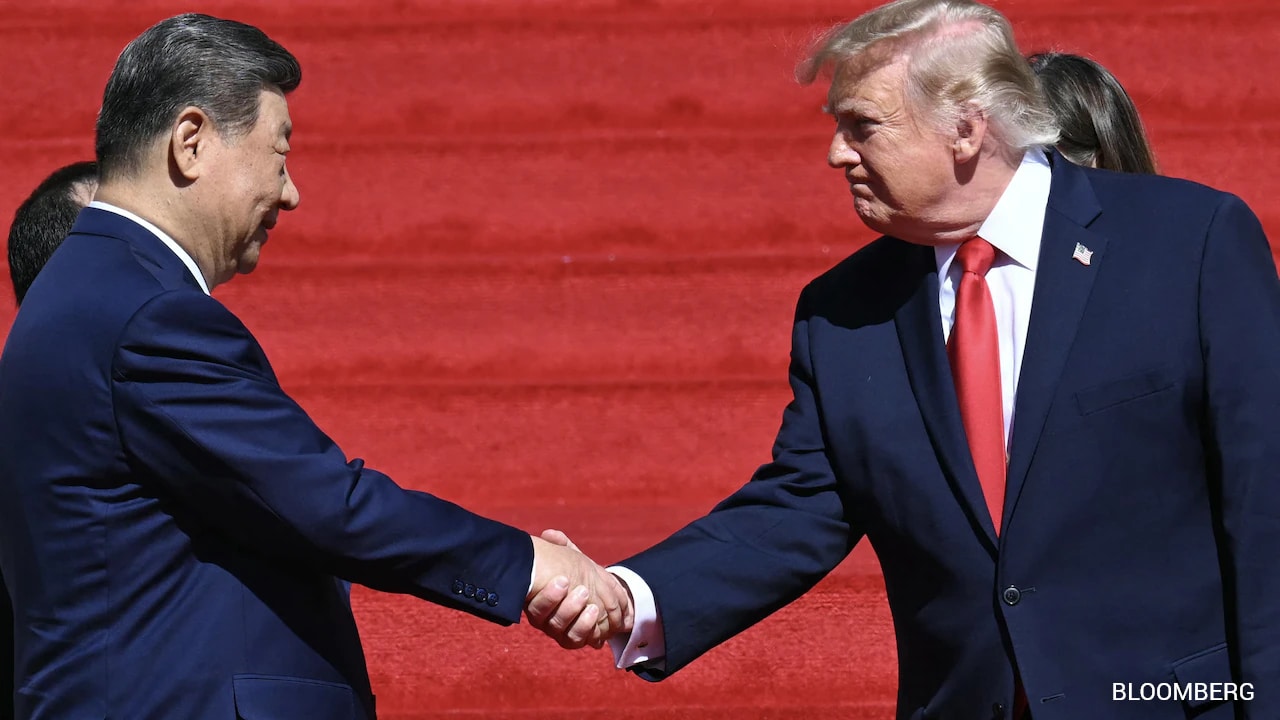
Beijing’s diplomatic posture toward Donald Trump operates on a calculated asymmetric bet: transactional predictability outweighs ideological hostility, even when domestic political reversals in Washington introduce severe structural volatility. Standard geopolitical commentary misreads this dynamic by framing China’s approach as mere optimism or passive waiting. In reality, the Chinese leadership executes a disciplined risk-management strategy built on game theory, economic leverage, and institutional memory. When a political shock—such as a sweeping electoral or legislative setback described in Western media as a "total defeat"—alters the domestic standing of the American executive, Beijing does not abandon its foundational thesis. Instead, it recalibrates the cost function of bilateral engagement to exploit the resulting policy friction in Washington.
To understand why Beijing maintains strategic patience toward a Trump administration despite escalating tariff threats and rhetoric, analysts must strip away surface-level diplomatic signaling and examine the underlying operational incentives.
The Structural Logic of Transactional Realism
In international relations theory, states evaluate counterparts along two axes: capability and intent. Traditional Democratic administrations in Washington typically present Beijing with a high-capability, high-cohesion threat profile—utilizing multilateral alliances, ideological framing, and institutional rulemaking to constrain Chinese influence. Conversely, a Trump-led executive branch presents a bilateral, transactional model where ideological alliances are subordinated to immediate economic concessions.
Beijing’s strategic apparatus prefers a counterparty whose utility function is transparent. When policy outcomes are tied to measurable commercial metrics—such as agricultural purchase quotas, intellectual property enforcement mechanisms, or bilateral trade deficits—Chinese planners can model the exact price of stability.
Three core variables govern this preference:
- Disaggregation of Alliances: Unilateral American pressure fractures the united front between Washington, Brussels, and Tokyo. For Beijing, absorbing bilateral tariffs from the United States is structurally less damaging than facing a coordinated, multi-front regulatory blockade across the G7.
- Centralization of Decision-Making: A top-down executive style bypasses the entrenched bureaucratic consensus within the U.S. Department of State and the Department of Defense. Beijing views a single decision-maker as a target for direct negotiation, whereas an institutionalized consensus is virtually impossible to reverse.
- Predictable Escalation Ladders: Rhetorical extremism followed by tactical bargaining creates a known sequence. Chinese policymakers have mapped this cycle since the 2018–2019 trade negotiations, allowing state-owned enterprises and monetary authorities to front-run tariff announcements through currency adjustments and supply chain rerouting.
Deconstructing the "Total Defeat" Variable
When domestic political setbacks—whether midterm congressional losses, judicial rebukes, or sub-national electoral collapses—weaken an American president's domestic mandate, the risk profile of U.S.-China relations shifts immediately. Conventional wisdom suggests a weakened president becomes more conciliatory abroad to secure foreign policy victories. Operational reality dictates the exact opposite.
A domestic political defeat alters the incentive structure of the White House in two dangerous ways:
- The Diversionary Escalation Trap: Deprived of legislative pathways to enact domestic economic priorities, the executive branch relies heavily on unilateral executive orders. Trade policy, sanctions, and export controls require minimal congressional approval. A politically cornered administration faces intense pressure to project strength externally, turning China into the primary release valve for domestic political frustration.
- The Credibility Deficit in Negotiations: Agreements struck with a politically diminished executive carry high reversal risk. If Beijing makes structural economic concessions to secure a bilateral deal, those concessions may be invalidated by a hostile Congress or overturned by a subsequent administration. The expected value of any long-term treaty drops precipitously.
Beijing recognizes that a "total defeat" for its preferred negotiating partner in Washington does not produce an easy compromise; it produces a volatile, unpredictable actor operating with a shortened time horizon.
The Three Pillars of Beijing’s Risk Mitigation
Rather than reacting to daily fluctuations in Washington’s political climate, China’s economic and foreign policy apparatus insulates itself through three distinct operational mechanisms.
1. Supply Chain Rerouting and Trade Diversion
Since the initial imposition of Section 301 tariffs, Chinese manufacturing has systematically decoupled its final assembly stages from direct mainland exports to the United States. By shifting intermediate goods to production hubs in Vietnam, Malaysia, and Mexico, Beijing reduces its direct exposure to bilateral tariff hikes. When Washington threatens across-the-board duties, the immediate shock is absorbed by third-party transshipment networks, buying Chinese exporters critical adjustment windows.
2. Asymmetric Retaliation Targeting Political Constituencies
Beijing does not match American tariffs dollar-for-dollar, as China imports significantly less from the United States than it exports. Instead, Chinese trade authorities apply precision targeting. Retaliatory measures focus on sectors with high political sensitivity and low substitution costs for China—specifically U.S. agriculture, liquefied natural gas, and aerospace. By imposing targeted economic pain on specific electoral districts, Beijing forces domestic American lobbying groups to exert internal pressure on the White House, effectively outsourcing its diplomatic counter-offensive to U.S. domestic stakeholders.
3. Strategic Ambiguity on Taiwan and Regional Security
While economic friction remains manageable through transactional bargaining, security flashpoints represent non-linear risks. When domestic political setbacks increase the likelihood of erratic executive behavior in Washington, Beijing tightens its military signaling around the Taiwan Strait and the South China Sea. The objective is deterrence through clarity: establishing unmistakable red lines so that a weakened U.S. administration does not miscalculate and trigger an unintended military crisis to distract from domestic failures.
Mapping the Cause-and-Effect Chains
The central failure of superficial geopolitical reporting is treating economic friction and domestic political instability as isolated events. In practice, they form a closed feedback loop that dictates bilateral stability.
[Domestic U.S. Political Setback]
       │
       ▼
[Loss of Legislative Agenda] ──► [Reliance on Unilateral Executive Action]
       │                                      │
       ▼                                      ▼
[Heightened Anti-China Rhetoric] ◄── [Escalation of Tariffs & Export Controls]
       │
       ▼
[Beijing Recalculates Deal Viability] ──► [Shift from Bilateral Deals to Domestic Stimulus]
When the first node—a major political defeat—occurs, it accelerates the transition from negotiated trade frameworks to unilateral economic warfare. Beijing’s "faith" in Trump is therefore conditional. It is not faith in the individual, nor an expectation of benign treatment; it is confidence in the predictability of his transactional nature so long as he retains sufficient domestic political capital to enforce a bargain. Once that political capital evaporates, Beijing’s calculus shifts from deal-making to pure damage control.
Operational Limitations of China’s Approach
Beijing’s strategy is rigorously logical, yet it suffers from three structural blind spots that limit its effectiveness:
- Underestimating Ideological Entrenchment: Chinese analysts frequently assume that American corporate lobbyists can still restrain Washington’s national security apparatus. This assumption is outdated. Consensus across both American political parties has hardened around technological containment, meaning Wall Street and Silicon Valley no longer possess the political veto power they exercised a decade ago.
- Domestic Economic Fragility: China’s capacity to absorb external shocks is constrained by its own structural headwinds—specifically a prolonged real estate contraction, local government debt overhangs, and weak domestic consumption. Deploying massive fiscal stimulus to offset U.S. tariffs carries diminishing returns and exacerbates internal debt ratios.
- The Misinterpretation of Political Theater: Authoritarian systems often struggle to distinguish between American campaign rhetoric and actionable policy intent. Overreacting to rhetorical provocations intended for domestic U.S. consumption can inadvertently lock Beijing into rigid diplomatic postures, closing off off-ramps that the White House never intended to block.
The Definitive Strategic Play
To navigate a U.S. executive branch weakened by domestic political reversals yet committed to aggressive unilateralism, Beijing must execute a calibrated dual-track maneuver over the next two quarters.
First, Chinese negotiators must avoid offering front-loaded, irreversible structural concessions in exchange for temporary tariff relief, as a politically compromised White House lacks the institutional durability to guarantee long-term compliance. Instead, Beijing should structure any bilateral agreements around short-cycle, reversible deliverables—such as phased commodity purchases tied directly to rolling 90-day tariff suspensions. This mirrors Washington’s shortened time horizon and eliminates the risk of unreciprocated concessions.
Second, Beijing must immediately reallocate diplomatic bandwidth away from the White House and toward sub-national American actors and third-party trade blocs. By accelerating bilateral investment treaties with European and ASEAN economies while simultaneously engaging U.S. state governors and agricultural associations directly, China can raise the domestic political cost of unilateral American escalation. The objective is not to defeat Washington’s executive branch at the negotiating table, but to surround it with an economic reality where the domestic price of ideological containment exceeds its political utility.