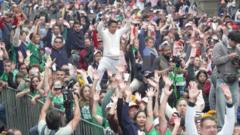
Mexico City just tried to pull off something massive. Tens of thousands of people gathered in the iconic Zócalo plaza with one specific goal. They wanted to break the world record for the largest synchronized human wave. If you've ever been to a stadium, you know how this works. One section stands up and raises their arms, then the next, creating a moving ripple through the crowd. It looks simple. It looks like pure fun.
But organizing this scale of crowd movement in the heart of one of the world's largest metropolises is a logistical nightmare.
Most media outlets covered this as a quirky local news story. They snapped a few photos of smiling faces, listed the estimated attendance numbers, and moved on. That misses the point entirely. This record attempt isn't just about getting into a book of world records. It shows how cities can use massive, coordinated public events to rebuild community spirit, test urban infrastructure, and boost local economies after years of digital isolation.
The Logistics Behind the Mexico City Wave
You can't just yell at a crowd of ninety thousand people and expect them to move in perfect harmony. It takes months of planning. Mexico City officials utilized local community leaders, megaphone stations, and synchronized stage cues to coordinate the movement across the massive plaza.
The current official record for the largest human wave belongs to a stadium crowd, where seating charts make coordination relatively straightforward. The Zócalo is a flat, open plaza. There are no rows. There are no aisles to separate sections. This structural reality makes a continuous wave incredibly difficult to maintain.
Think about the sheer physics involved. A human wave travels at about twelve meters per second. It requires split-second timing. If one group pauses or reacts too slowly, the momentum dies instantly. During the Mexico City wave attempt, coordinators positioned spotters on elevated platforms around the square. These spotters used colored flags to signal when different quadrants of the crowd needed to initiate their movement. It was a massive experiment in human behavioral synchronization.
Why Mass Public Gatherings Are Crucial Right Now
People are lonelier than ever. We spend our days staring at screens, working remotely, and interacting through apps. Virtual connections don't satisfy our fundamental need for physical community.
Mass public events serve as an antidote to this isolation. When you stand shoulder-to-shoulder with thousands of strangers, moving in unison, something changes in your brain chemistry. Psychologists call this collective effervescence. It's the synchronized high that happens when a community comes together for a shared, non-commercial purpose.
Local governments are starting to realize the value of these initiatives. They aren't just frivolous parties. They are strategic tools for civic engagement. A connected citizenry is a resilient citizenry. When people feel a sense of ownership and belonging in their city's public spaces, crime rates drop, civic participation increases, and social trust grows. Mexico City is leveraging this better than almost anyone else in Latin America.
The Economic Ripple Effect of Breaking Records
Let's look at the hard numbers. An event like this brings an immense influx of foot traffic to the historic center of the city.
Street vendors, local restaurants, boutique hotels, and public transit systems all see massive spikes in revenue during these public assemblies. The city government estimated that the influx of visitors for the weekend celebration generated millions of pesos in economic activity.
- Street food vendors reported selling out of inventory hours ahead of schedule.
- Public transportation systems handled a thirty percent increase in ridership without major delays.
- Nearby hotel occupancy rates hit near-capacity levels for a standard weekend.
This economic boost matters. It flows directly into the pockets of everyday working people, not just large corporate chains. The economic ripple effect of a free public event often outweighs the initial administrative costs of organizing it.
How to Scale Crowd Coordination in Your Own Community
You don't need a historic plaza or ninety thousand people to apply these principles. Smaller communities can use the same tactics to bring people together and revitalize local spaces.
Start by focusing on low-barrier, high-participation activities. The beauty of a human wave is that anyone can do it. It doesn't require special skills, expensive equipment, or linguistic fluency. It bridges age gaps and socioeconomic divides.
Focus on clear, visual communication lines. If you're organizing a community event, don't rely on audio systems alone. Sound distorts over distances and gets drowned out by crowd noise. Use bright, elevated visual cues to direct people. Assign neighborhood captains to manage small clusters of participants. Break the large crowd down into manageable units, then synchronize those units from a central command point. Most importantly, give people a clear, singular goal. Whether it's a massive group photo, a synchronized dance, or a simple human wave, a unified objective creates instant camaraderie. Turn the event into a shared challenge, and watch the community show up to meet it.