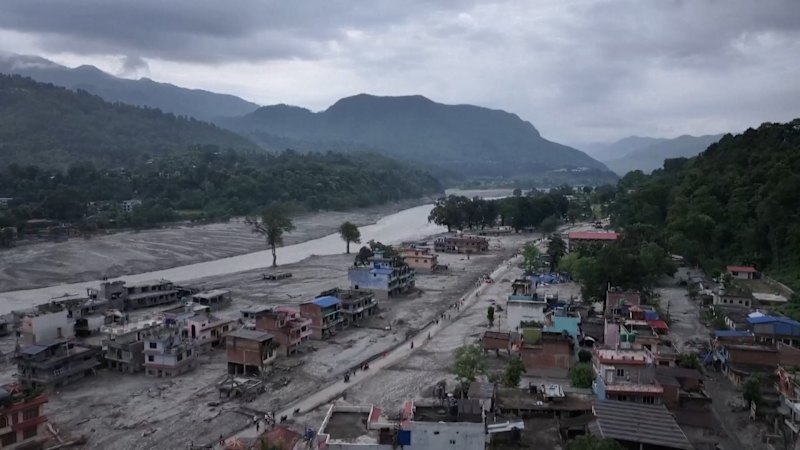
Water does not always arrive as a gentle guest. Sometimes, it comes as an accumulation of ancient terrors, a slate-gray wall of mud and stone tearing down the ribs of the earth at sixty miles an hour.
Ask anyone who has stood in the foothills of the Himalayas during the monsoons. You do not hear the flood until the ground begins to vibrate through the soles of your feet. It starts as a low, sullen growl, like an engine deep beneath the floorboards of the world. Then comes the smell—crushed pine, raw clay, and the copper tang of overturned earth. And finally, the sound itself: a monstrous, grinding roar of boulders chewing against boulders, erasing centuries of human patience in the span of a single heartbeat.
The numbers attached to the recent disaster in Nepal are difficult to look at squarely. At least eight hundred lives swallowed by the earth. Entire villages mapped out in pencil now rendered as blank spaces on wet paper. Statistics are efficient. They allow distant minds to process tragedy without breaking. But eight hundred is not a statistic. Eight hundred is a grocery list left unfinished on a kitchen table. It is a pair of damp school shoes sitting by a doorway that no longer has walls. It is a grandfather who spent forty years terracing a hillside with his bare hands, only to watch the slope unlatch itself and slide into the valley below.
To understand how an entire community can vanish while the rest of the world scrolls past on illuminated glass, you have to look at the geometry of the tragedy.
Nepal is carved by gravity. Its vertical villages cling to mountain flanks like lichen, stunningly beautiful, intimately connected to the monsoon cycles that have nourished South Asia for millennia. But the rhythm has broken. The sky is no longer behaving the way the old songs said it would. When a tropical depression stalls over the Bay of Bengal and pumps an ocean of moisture straight up against the roof of the world, the earth simply surrenders.
Consider what happens when three months of rain falls in forty-eight hours. The soil, already loosened by unseasonal deforestation and the frantic carving of rural roads, turns from a solid foundation into a liquid piston.
I remember talking to a man in Sindhupalchok a few years ago, long before this latest catastrophe, while reporting on smaller landslides. He pointed up at a jagged scar of red clay high above his stone-built home. He didn't speak of climate science or meteorological shifts. He spoke of the mountain as if it were a restless animal chained to his backyard.
"The mountain is heavy," he told me, stirring a cup of milky tea over a small kerosene stove. "And every year, it gets tired of holding itself up."
That tiredness is now a continental crisis.
When the floodwaters hit the lowlands and the mountain torrents converged on the river basins, they carried more than just water. They carried the history of the highlands. Bridges that had stood since the Rana dynasty snapped like dry twigs. Highways vanished into churning gray lakes. In places like Kathmandu Valley and the surrounding districts, rescue helicopters became the only punctuation marks in a sky choked with low-hanging clouds.
Yet, the true horror of such disasters is rarely found in the immediate impact. It lives in the slow, agonizing aftermath.
Water recedes. Mud dries into a concrete-like crust that must be chipped away with mattocks and spoons. And then the silence sets in.
In the emergency camps pitched on damp asphalt and schoolyards, the air smells of woodsmoke, disinfectant, and unwashed wool. Mothers sit staring at empty patches of ground where their children were sleeping when the walls caved in. Aid workers navigate a labyrinth of washed-out bridges, trying to deliver water purification tablets to communities that no longer have wells, let alone cups. Cholera and dysentery wait in the puddles, patient scavengers picking at the bones of the survivors.
We are living through an era where extreme weather has stopped being an anomaly and has settled in as the tenant upstairs. We have altered the chemistry of the atmosphere, and the atmosphere is answering in a language of mud and drownings. Every ton of carbon pumped into the sky somewhere in a distant metropolis has a distant cousin in the falling of a hillside in Kavre or the overflowing of the Koshi River.
It is easy to look at the Himalayas as a distant sanctuary, a postcard backdrop for mountaineers and trekkers seeking enlightenment. We romanticize their isolation. We forget that millions of flesh-and-blood human beings live in the folds of those giant rocks, trying to grow corn, send their kids to school, and live quiet lives under the shadow of geological time.
When the mountains come down, they do not care about geopolitics. They do not pause for economic summits or carbon credit debates. They simply obey the ancient, brutal laws of physics.
As the sun finally breaks through the monsoon haze over the valleys of Nepal, illuminating the orange rescue tarps and the weeping families digging through the gray ruins of their homes, the silence of the survivors is deafening. They are not asking why the gods are angry. They are simply wondering where to plant their feet tomorrow, in a world where the ground itself has decided to leave.