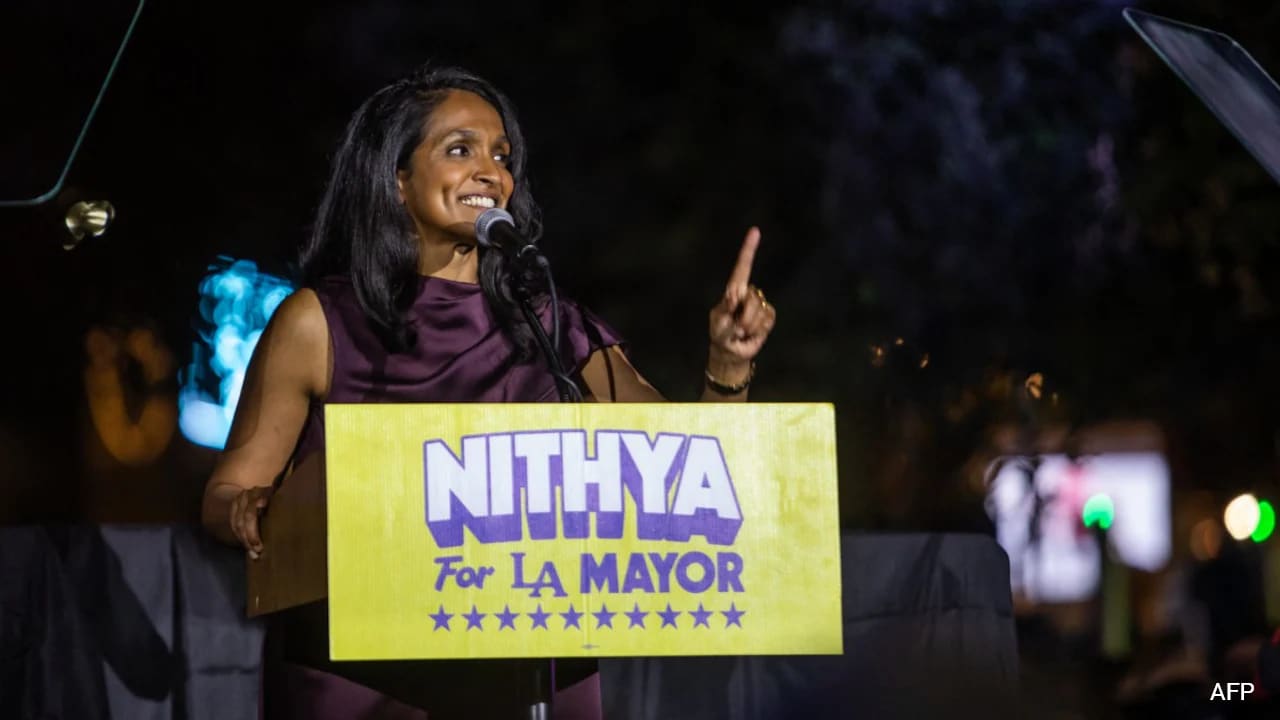
Most people assume Los Angeles politics gets run by career insiders who spent decades climbing the local party ladder. Nithya Raman broke that script completely, and her run for Los Angeles Mayor shows just how far an urban planner who cut her teeth in Delhi's informal settlements can push City Hall.
If you look at Nithya Raman's journey from Kerala to Los Angeles Mayor via Delhi slums, it reads less like a traditional political resume and more like an education in how cities actually fail working people. She wasn't raised inside political clubs or groomed for office by wealthy donors. Instead, she grew up between India and the United States, studied how cities function at Harvard and MIT, spent years working directly with slum residents in Delhi and Chennai, and then brought those exact lessons back to LA's homelessness crisis.
That background explains why establishment politicians in Los Angeles underestimated her in 2020 and why her subsequent mayoral bid shook up city politics. You don't learn how sanitation, housing, and basic municipal services work by reading policy memos in a comfortable office. You learn it when you're standing in a neighborhood where the government refuses to build a toilet or recognize a family's right to stay on the land they've lived on for twenty years.
Growing Up Between Kerala and Louisiana
Nithya Raman was born in Kerala, India, and moved to the United States with her family when she was six years old. They settled in Baton Rouge, Louisiana, which couldn't have been more different from southern India.
Moving across the world as a kid gives you a specific kind of perspective. You notice right away what's normal in one place and completely broken in another. Growing up in Baton Rouge as an immigrant kid meant navigating two worlds at once, and it made her hyper-aware of how neighborhoods are built, who gets resources, and who gets left behind.
Her parents valued education, and she eventually headed north for college, earning her undergraduate degree from Harvard University before completing a master's degree in urban planning at the Massachusetts Institute of Technology. On paper, that's the classic elite academic track. Most people with a Harvard-MIT pedigree take comfortable consulting gigs, join think tanks, or slide into high-paying real estate development jobs.
Raman went in the opposite direction. She went back to India to work on the ground where urban planning wasn't an abstract theory, it was a daily fight for survival.
What Delhi Slums Taught Her About City Government
When you talk about urban planning in fast-growing Indian cities, you're talking about millions of people living in informal settlements that municipal governments pretend don't exist. Raman spent years in India working on sanitation, housing rights, and local governance, including founding Transparent Chennai, a research and advocacy organization focused on making city data public and forcing municipal officials to address the needs of low-income residents.
Her work in Delhi and Chennai stripped away any illusions about how bureaucracy operates. In many Indian slums, residents weren't lacking work ethic or community organization. They lacked legal recognition. Because the city classified their neighborhoods as illegal or temporary, municipal agencies refused to connect them to water lines, sewage systems, or trash collection.
Think about that dynamic for a second. A city government creates a legal category that declares tens of thousands of residents invisible, and then uses that category as an excuse not to provide basic human services.
Raman spent her time mapping those communities, documenting what residents actually needed, and pushing local officials to stop treating poor neighborhoods like eyesores to be bulldozed. She saw firsthand how data and community organizing could force stubborn bureaucracies to move. When you can show a city agency exact maps of missing toilets, broken water pipes, and uncollected garbage, bureaucrats can't hide behind vague excuses anymore.
Honestly, it's the exact same structural blindness she later found in Los Angeles. Different country, vastly different wealth levels, same bureaucratic refusal to deal with housing as a basic human need.
Bringing Grassroots Organizing to Silver Lake and LA
After returning to the United States and settling in Los Angeles, Raman didn't immediately run for office. She did what good organizers always do—she looked around her own neighborhood and started showing up to local meetings.
Living in Silver Lake, she saw the homelessness crisis exploding across Los Angeles in real time. Sidewalks were filling up with tents, rents were skyrocketing, and City Hall seemed completely paralyzed. Politicians talked endlessly about compassion while passing ordinances that simply pushed unhoused people from one street corner to the next.
In 2017, Raman co-founded the SELAH Neighborhood Homeless Coalition, a grassroots volunteer group operating across Silver Lake, Echo Park, Los Feliz, Atwater Village, and Hollywood. Instead of waiting for the city to fix things, SELAH volunteers went out every week to distribute food, hygiene kits, and water, while helping unhoused neighbors navigate the maze of housing paperwork and social services.
That hands-on experience mattered. A lot.
When you spend Saturday mornings helping someone replace a lost ID card or figure out why their housing voucher stalled in bureaucracy, you learn quickly that LA's homelessness system isn't just underfunded—it's badly designed. People weren't staying on the streets because they loved living in tents. They were stuck on the streets because getting into shelter required jumping through hoops that even a housed person with a laptop and a car would struggle to clear.
Shocking the Los Angeles Establishment in 2020
By 2020, Raman decided that volunteering around the edges of a broken system wasn't enough. She launched a campaign for Los Angeles City Council District 4, a sprawling district stretching from Silver Lake and Hollywood up into the San Fernando Valley.
Nobody in the political establishment gave her much of a chance. She was running against incumbent David Ryu, who had massive institutional backing, union endorsements, and a war chest full of traditional political money. In LA politics, incumbents almost never lose. City Council members routinely cruise to reelection because turnout is low and challengers rarely build enough ground support to overcome name recognition.
Raman ran a completely different kind of campaign. Backed by the Democratic Socialists of America's Los Angeles chapter and an army of thousands of small-dollar donors and volunteers, she built a massive door-knocking and phone-banking operation. Her platform focused squarely on tenant protections, a humane and housing-first response to homelessness, and reforming policing by shifting funds toward unarmed crisis response.
When the votes were counted in November 2020, she didn't just squeak by—she defeated David Ryu decisively, becoming the first South Asian American and the first woman of color elected to the Los Angeles City Council in years, and marking a major shift in local politics.
Governing Inside City Hall and Facing Reality
Winning an election as an outsider is one thing. Governing inside a rigid, often dysfunctional municipal machine is something else entirely.
Once Raman took office in December 2020, she quickly discovered that changing City Hall from the inside takes serious grit. Los Angeles gives its 15 City Council members enormous individual power over land use and homelessness enforcement within their own districts, which often leads to turf wars rather than citywide solutions.
During her first term, Raman pushed hard to expand tenant protections, including advocating for universal eviction defense and stronger rules against unfair rent hikes. She also fought to create alternative crisis response teams so armed police officers wouldn't be the default responders to mental health calls.
At the same time, she faced intense pushback from both sides. Conservative critics and some homeowner groups accused her of being too lenient on street encampments, arguing that neighborhoods were becoming unsafe and dirty. Meanwhile, some left-wing activists criticized her whenever encampment clearings happened in her district, even when paired with housing offers.
Redistricting in 2021 also threw a massive curveball at her political career. The city's redistricting commission redrew District 4's boundaries, cutting out large chunks of her progressive base in Silver Lake and Los Feliz and adding more moderate, affluent neighborhoods in the San Fernando Valley. Many political observers assumed the new map was specifically designed to end her career in 2024.
Instead, Raman leaned into constituent services, secured major funding for permanent supportive housing and shelter programs in her district, and won reelection in the March 2024 primary outright, avoiding a runoff altogether. That victory proved she wasn't just a fluke candidate riding a wave—she had learned how to win over skeptical voters by showing up and delivering tangible local results.
Why Her Run for Los Angeles Mayor Matters
When Nithya Raman entered the race for Los Angeles Mayor, it wasn't just another politician chasing a promotion. It represented a direct clash between two fundamentally different theories of how a major American city should be run.
Los Angeles has spent billions of dollars over the past decade trying to address homelessness and housing affordability, yet tens of thousands of people still sleep on the streets every night. Voters are exhausted. Business owners are frustrated. Renters feel like they're one paycheck away from eviction.
Raman's pitch for the mayor's office comes straight from her entire life's trajectory—from observing civic inequality as a kid between Kerala and Baton Rouge, to mapping overlooked neighborhoods in Delhi and Chennai, to organizing neighbors in Silver Lake. Her core argument is simple: you cannot arrest or sweep your way out of a housing shortage. If a city doesn't build enough affordable housing, protect tenants from predatory evictions, and fix the broken pipeline between street outreach and permanent shelter, no amount of tough talk from City Hall will clear the sidewalks.
Critics argue that her approach takes too long when residents want immediate relief from street encampments and crime. That's a fair tension, and it's the central debate defining Los Angeles politics right now. Voters want visible, immediate improvements on their streets, while urban planners like Raman argue that short-term sweeps without housing placements just shuffle human misery from one block to another without solving anything.
Common Misconceptions About Nithya Raman's Background
Because political campaigns love simple labels, people often get key parts of Raman's story wrong. Clearing up a few of those myths helps explain how she actually operates:
- She isn't an anti-data ideologue. Critics sometimes paint progressive politicians as purely emotional activists. Raman is trained as an MIT urban planner who spent years building public data portals in India. Her policy arguments usually rely heavily on municipal budget numbers, housing unit counts, and service delivery metrics.
- Her work in India wasn't charity tourism. She didn't drop into Delhi for a summer internship to pad a resume. She lived and worked in India for years, building organizations focused on municipal accountability and learning how cities exclude low-income residents through zoning and legal technicalities.
- She doesn't oppose all encampment interventions. While she famously opposed blanket criminalization laws like LA's Municipal Code 41.18—which bans sitting, lying, or sleeping in broad zones across the city—she has supported targeted encampment resolutions when real housing or shelter beds are actually available for the people living there.
What You Can Learn From Her Political Path
Whether you agree with every policy Nithya Raman backs or not, her rise offers a clear blueprint for anyone trying to change local government. Most people obsess over national politics while ignoring the local offices that actually control housing, transit, policing, and city budgets.
If you want to have real impact in your own city, start where she did. Show up to neighborhood council meetings where land-use decisions get made before projects ever reach the city council. Volunteer with local mutual aid or housing groups so you understand how city policies affect real people on the ground rather than relying on cable news talking points. Track how your city actually spends its housing and infrastructure money, and hold local representatives accountable for measurable outcomes instead of press conferences. Cities change when regular residents refuse to let bureaucracy hide behind excuses.