Airports are purgatories built of fluorescent light, rolling suitcases, and borrowed time. Everyone moves through them with a quiet urgency, trying to get from who they were at takeoff to who they need to be at arrival.
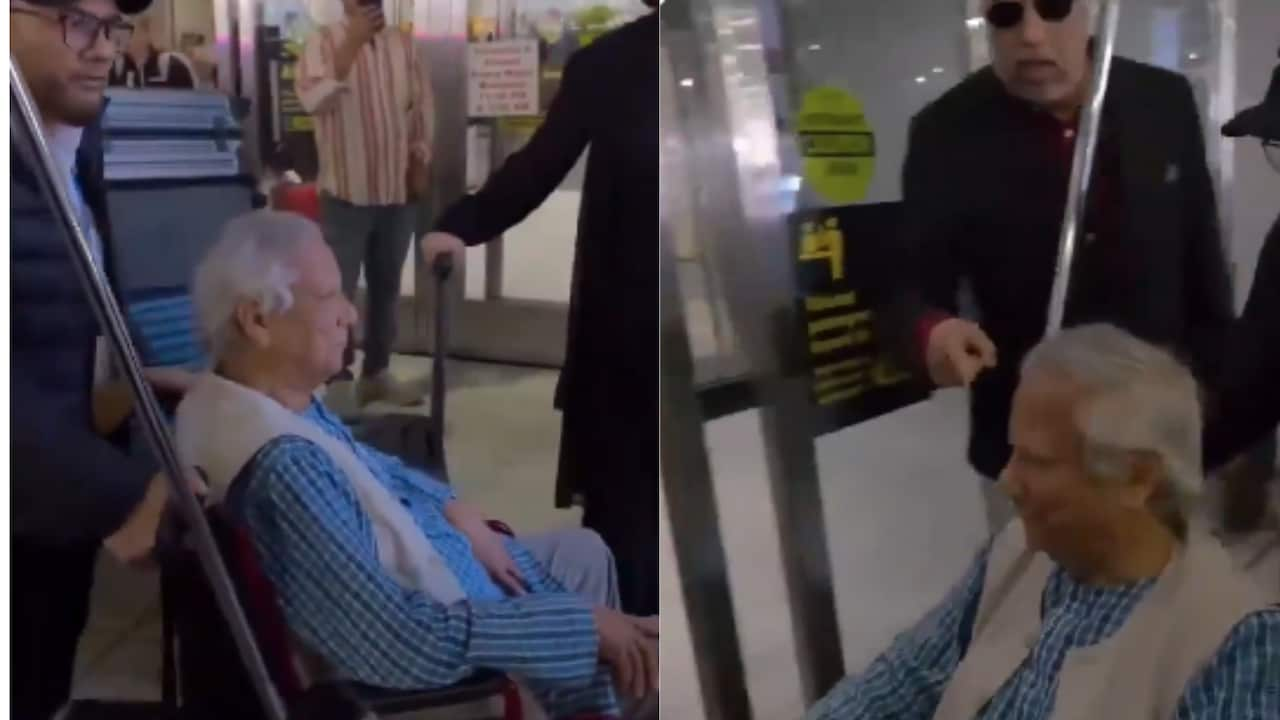
Now picture an elderly man stepping past sliding glass doors into the brisk air outside a New York terminal. Decades of public life have thinned his frame and silvered his hair, yet his posture still carries the quiet weight of someone who spent half a century arguing that poor people deserve credit without collateral. He has won the Nobel Peace Prize. He has stood in rooms where world leaders spoke softly about poverty alleviation while millions of families lived on the edge of ruin.
Then comes the noise.
Voices rise before the first step is even finished. Shouts cut through the hum of traffic and idling buses. A word is hurled into the open air—terrorist—aimed at a man whose entire life's work centered on tiny loans to rural women so they could buy a sewing machine, a goat, or a weaving loom and feed their children.
Heckled. Cornered by anger in a place meant for transit.
At first glance, a scene like that can look like simple political theater. Angry crowd, prominent figure, chaotic footage, twenty-four hours of outrage before the algorithm moves on to the next clash. I have watched enough public disputes over the years to feel the familiar knot in my stomach when a story shrinks into a shouting match. Something vital slips away when a complex national rift gets compressed into a single ugly word yelled outside a terminal.
Truth is often the first casualty of volume.
A word like "terrorist" is not an ordinary insult. It carries heavy legal, moral, and emotional weight. When people throw it at a Nobel laureate in a public walkway, they are not offering a calm audit of policy decisions or economic statistics. They are expressing raw fury, deep polarization, and a sense of betrayal that has been building long before any flight landed in New York.
To understand what really happened at that airport gate, we have to step back from the shouting and look at what happens when long-simmering national divisions cross an ocean and collide in front of a camera.
How a Symbol Becomes a Target
Public figures rarely get heckled in a vacuum. Long before anyone stands behind a barricade or holds up a sign near an arrival curb, a person's name has already been turned into shorthand for larger arguments.
For decades, Muhammad Yunus was celebrated across much of the world as a gentle revolutionary. In the 1970s and 1980s, watching hunger and predatory lending trap people in cycles they could never climb out of, he championed microcredit—small loans extended to people banks considered too poor to trust. His model spread far beyond South Asia, inspiring anti-poverty programs across continents and earning him global recognition, culminating in the 2006 Nobel Peace Prize alongside Grameen Bank.
To admirers, that story looked like proof that dignity could scale. Small sums of money, paired with trust and community accountability, could help a mother start a small business and send her daughter to school.
Yet history rarely moves in a straight line of applause.
Over time, supporters and critics began reading the exact same life through completely different lenses. What some saw as principled reform and global moral authority, others viewed through the lens of bitter political rivalries, institutional battles, or deep anger over national events. Once a figure becomes tied to high-stakes power struggles and intense domestic passions, nuance evaporates fast. A complex legacy turns into a banner.
And banners draw crowds.
Consider what happens next when exile, politics, and diaspora life mix in a major global city. New York is home to vibrant communities with strong ties to events back home, where memories of past grievances and recent upheavals remain sharp. When a polarizing or high-profile figure arrives there, emotions that might stay muted in everyday life often surface all at once.
I have stood in crowded public spaces during tense moments and felt how quickly a small group of loud voices can change the temperature of an entire block. You hear the cadence of chants. You see phones raised like shields or weapons. You feel the awkwardness of bystanders who came to pick up a cousin or catch a cab and suddenly find themselves standing inside a political storm.
It is unsettling. Even when you disagree strongly with a public figure's actions or choices, watching raw hostility erupt at an airport curb forces a harder question: what does this kind of spectacle actually accomplish?
The Hypothetical Bystander at the Curb
To see the human cost beyond the headlines, let us construct a hypothetical scenario—a composite picture grounded in real patterns of migration and political division rather than a single documented individual.
Imagine a hypothetical traveler named Tariq waiting near the terminal exit with a crumpled piece of paper bearing a relative's name. Tariq left his home country years ago chasing stability, sending money back when times got tough, arguing at family dinners over every twist in national politics. He has strong opinions—some sharp, some conflicted—about how leaders have governed and who bears blame for hardship.
When the shouting starts around him, Tariq freezes. He did not come for a protest. He came for a family reunion. Watching an elderly man get pelted with angry accusations in front of strangers does not settle a single policy debate. Instead, it leaves Tariq feeling caught between two extremes: a fierce loyalty to his own grievances on one side, and a quiet discomfort with public humiliation on the other.
That tension is real for millions of ordinary people caught between polarized camps. Most human beings do not live inside slogans. They live inside mortgages, school fees, family loyalties, and fading hopes that tomorrow might be slightly steadier than today.
When public discourse turns into a shouting match at a baggage claim exit, nobody's real problems get solved. A heckler may feel a brief rush of release—the satisfaction of making a powerful or famous person hear their anger face-to-face. Yet anger yelled across a sidewalk rarely persuades a single skeptic. Often, it hardens the other side and turns a serious argument into a spectacle.
Why Words Like "Terrorist" Distort the Stakes
There is a reason a single label can hijack an entire story.
In modern public life, extreme words act like gasoline on dry brush. Calling someone a "terrorist" is not a minor disagreement over tax policy, administrative appointments, or economic strategy. It is an accusation of extreme violence and existential threat. When hurled casually or polemically at a figure whose global identity is tied to microfinance and peace awards, the clash itself becomes the headline—often eclipsing whatever underlying grievances motivated the protesters in the first place.
Think of it like a smoke alarm pulled during a kitchen argument. Suddenly everyone is staring at the flashing lights and covering their ears, while the actual issue that started the fight gets lost in the din. (That is a metaphor for how extreme labels crowd out substance, not a claim that real grievances do not exist.)
Real grievances deserve serious scrutiny. When citizens feel angry about political shifts, economic strain, institutional conflicts, or leadership decisions, those concerns belong in open debate, credible reporting, and accountable governance. Suppressing criticism is dangerous. Pretending a beloved global figure is above scrutiny is just as unhealthy.
Public life requires tough questions. It requires holding leaders, reformers, and icons alike to clear standards and verifiable facts.
Shouting insults outside a terminal does not do that work. It substitutes noise for argument.
What Gets Lost When Spectacle Wins
I will admit something openly: trying to make sense of modern political fury can feel exhausting. Some days the noise feels so loud that reasonable conversation seems almost quaint. You look at a clip from an airport walkway—shouts echoing off concrete, security stepping in, cameras rolling—and wonder how civil disagreement got buried under so much hostility.
Part of the answer lies in how attention works today. Calm explanations take time. Context requires patience. A heated confrontation outside an airport gate takes ten seconds to film and three seconds to share.
Yet the moments that travel fastest are rarely the ones that build understanding. A heckling incident at a New York airport tells us plenty about anger, polarization, and the friction of international politics. It tells us almost nothing about whether a microcredit borrower in a rural village can pay for medicine this month, or whether a country's institutions will grow stronger or more fractured over the next decade.
Real stakes are quieter than slogans. They live in courtrooms, classrooms, markets, and kitchen tables. They show up in whether people trust public institutions, whether dissent can be voiced safely without descending into intimidation, and whether societies can argue fiercely without reducing every opponent to a caricature.
When a Nobel laureate is met at an airport by critics yelling "terrorist," the contrast itself is jarring—a collision of global prestige, bitter political resentment, and street-level fury. Looking closely at that collision does not require excusing anyone or ignoring hard questions. It simply asks us to look past the volume and see the human weight underneath.
A crowd disperses. Cars pull away from the curb. The automatic doors keep sliding open and shut for the next flight, and the next, and the next.
Long after the shouts fade into the roar of jet engines overhead, the harder work remains: deciding whether we want a public square defined by who can scream loudest at the gate, or one strong enough to handle the truth without losing its humanity.