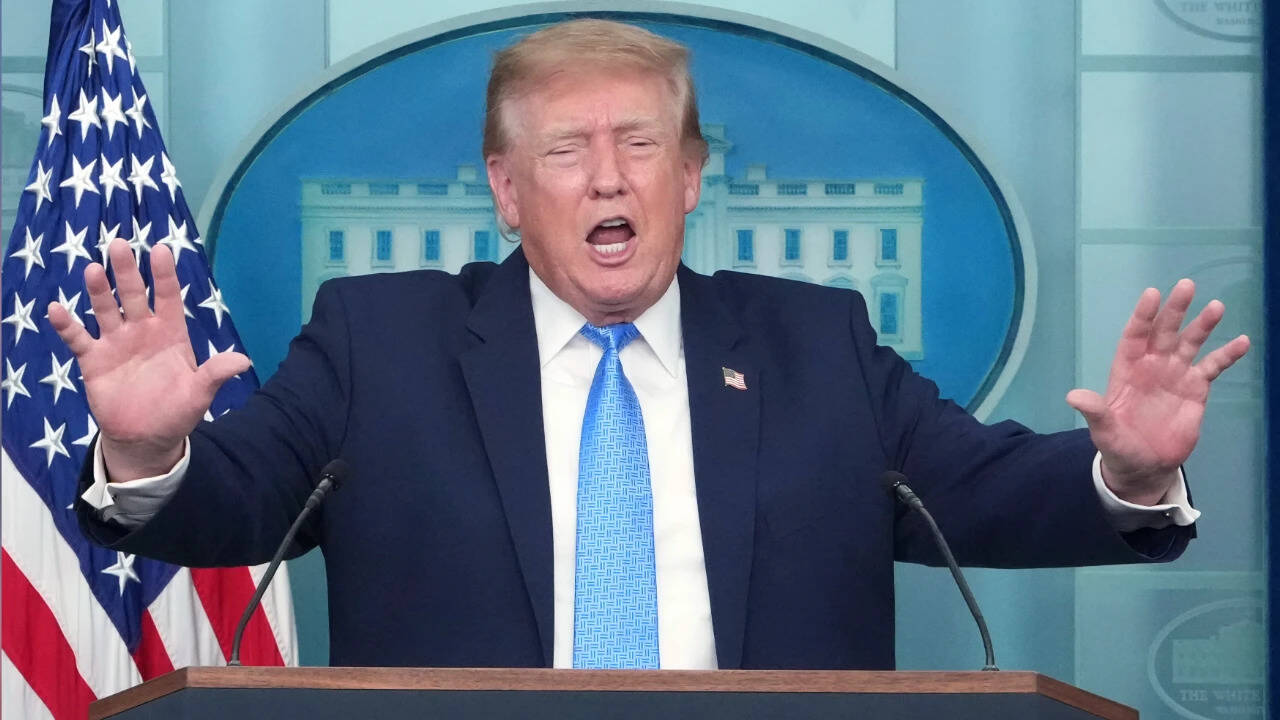
Two nuclear-armed or threshold powers don't trade threats like "locked and loaded" and demands for "surrender" by accident. When headlines flare up around Donald Trump warning Iran while Tehran demands Washington back down, most casual readers assume an all-out war starts tomorrow morning. It rarely works like that.
If you've watched Middle East geopolitics closely for the past decade, you know that public rhetoric and backchannel reality often move in completely opposite directions. News outlets love the dramatic quotes because fear sells clicks. Yet understanding what actually drives these sharp escalations between Washington and Tehran requires looking past the loudest soundbites.
The History Behind the "Locked and Loaded" Rhetoric
This isn't the first time Donald Trump has used military readiness as a verbal sledgehammer against the Islamic Republic. During his first administration, similar language surfaced after the 2019 attacks on Saudi Aramco oil facilities and the 2020 strike that killed Islamic Revolutionary Guard Corps (IRGC) General Qasem Soleimani. According to reporting from outlets like Reuters and the Associated Press, Trump's framing relies heavily on maximum pressure—both economic and psychological.
The phrase "locked and loaded" signals to domestic audiences and regional allies that the United States holds overwhelming conventional military superiority. It's a classic deterrence posture. By stating openly that American forces are ready to respond to any provocation, the White House aims to raise the perceived cost of Iranian proxy attacks or nuclear advances before a single missile leaves a rail.
Tehran's leadership understands this playbook well. Iranian officials, including senior commanders in the IRGC and representatives from the Foreign Ministry, routinely counter American warnings by demanding that Washington "surrender" its regional posture, lift crippling economic sanctions, or withdraw troops from Iraq and Syria. As analysts at the International Crisis Group have noted for years, Iranian rhetoric is designed to project absolute defiance to domestic hardliners while signaling to neighbors that Iran won't be bullied into unilateral concessions.
Why Both Sides Escalate Publicly
You might wonder why diplomats don't just keep quiet if neither side wants a catastrophic regional war. The answer lies in domestic politics and leverage.
In Washington, projecting strength is non-negotiable for any president dealing with Iran. Following the 2018 U.S. withdrawal from the Joint Comprehensive Plan of Action (JCPOA), the diplomatic middle ground shrank dramatically. Critics of the deal argued it failed to curb Iran's ballistic missile program or its support for regional militias like Hezbollah and the Houthis. When tensions spike, Trump's messaging reinforces his image as an unpredictable leader willing to break conventional diplomatic rules—a strategy often called "madman theory" in international relations, originally associated with Richard Nixon.
In Tehran, the calculation is equally rigid. Supreme Leader Ayatollah Ali Khamenei and the political establishment view backing down under direct American threats as existential suicide. If the Iranian government appears to fold under pressure, it risks losing credibility with its core ideological base and its network of regional allies across the Levant and the Persian Gulf.
So you get a feedback loop. Washington issues a stark military warning. Tehran responds with maximalist demands for U.S. capitulation. Both leaders walk away able to tell their respective publics they didn't flinch.
What Analysts Actually Watch Instead of Headlines
If you want to know whether a rhetorical clash is turning into an actual shooting war, stop reading the speeches and start watching military logistics and oil markets.
Carrier Strike Groups and Air Defense Deployments
Words are cheap, even from the Oval Office or Tehran. Moving a U.S. Navy aircraft carrier strike group, deploying additional Patriot or THAAD missile defense batteries to Gulf states, or repositioning long-range bombers costs millions of dollars and takes weeks of planning. Pentagon press briefings and defense tracking reports from organizations like the U.S. Naval Institute give a much clearer picture of real escalation than a social media post or a press conference quote.
The Strait of Hormuz and Global Energy Flows
Roughly a fifth of the world's petroleum liquids pass through the Strait of Hormuz, according to data from the U.S. Energy Information Administration (EIA). Whenever Tehran feels cornered, maritime harassment of commercial tankers or threats to close the strait become primary pressure valves. Watch Brent crude prices and maritime insurance rates in the Persian Gulf. When traders and insurers panic, the threat is real. When oil prices barely budge after a fiery speech, the market is telling you the rhetoric is mostly theater.
Nuclear Enrichment Milestones
The International Atomic Energy Agency (IAEA) regularly publishes verification reports on Iran's uranium enrichment levels and centrifuge installations at facilities like Natanz and Fordow. Trump's sharpest warnings almost always correlate with IAEA findings showing Iran edging closer to weapons-grade enrichment thresholds, or with intelligence suggesting imminent attacks on U.S. personnel in the region.
Common Misconceptions About US-Iran Showdowns
Most commentary on these standoffs falls into two lazy traps. The first is assuming war is inevitable every time insults fly. The second is assuming the threats are completely empty bluffs. Both views miss the mark.
- Misconception 1: "Surrender" means literal military defeat. When Iranian officials demand the U.S. surrender, they aren't expecting American troops to lay down their arms. In Iranian political parlance, "surrender" means Washington abandoning its sanctions regime and accepting Iran's regional influence without conditions.
- Misconception 2: Trump wants a prolonged ground war. Trump has consistently campaigned against endless Middle Eastern interventions. His preference, demonstrated throughout his presidency, leans toward sharp, limited strikes paired with suffocating financial sanctions—not deploying hundreds of thousands of ground troops.
- Misconception 3: Sanctions have completely broken Iran's economy to the point of collapse. While U.S. sanctions have severely damaged the Iranian rial and driven high inflation, Tehran has adapted by building alternative trade networks, particularly through discounted oil sales to independent refineries in Asia, as documented by energy tracking firms like Kpler and Vortexa.
How to Follow This Story Without Falling for Clickbait
Reading breaking news on U.S.-Iran relations requires a filter. Because the competitor headline and similar breaking alerts often lack full context—sometimes circulating without clear dates or verified transcripts—you have to verify what's actually new versus what's recycled outrage.
First, check the primary source of any quote. Did the statement come from an official White House transcript, a verified social media account, or a state-run Iranian outlet like IRNA or Press TV? State media translations frequently sharpen or soften nuances depending on the target audience.
Second, look at regional reactions in Riyadh, Abu Dhabi, and Jerusalem. Gulf Arab states sit directly across the water from Iran and bear the immediate brunt of any retaliation. When Saudi or Emirati officials quietly push for de-escalation or engage in direct talks with Tehran, it signals they believe the current rhetoric is getting dangerously close to a miscalculation.
Third, pay attention to backchannel intermediaries. Countries like Oman, Qatar, and Switzerland (which represents U.S. interests in Iran) serve as quiet conduits when official diplomacy freezes. If diplomatic flights between Muscat and Tehran suddenly increase right after a public war of words, negotiations are likely happening behind closed doors.
Track the IAEA quarterly reports, monitor official Pentagon deployment announcements, and cross-reference breaking alerts against wire services like Reuters or the Associated Press before assuming the worst. Staying focused on physical troop movements, maritime shipping data, and verified diplomatic channels will tell you far more about where Washington and Tehran are headed than any headline ever will.