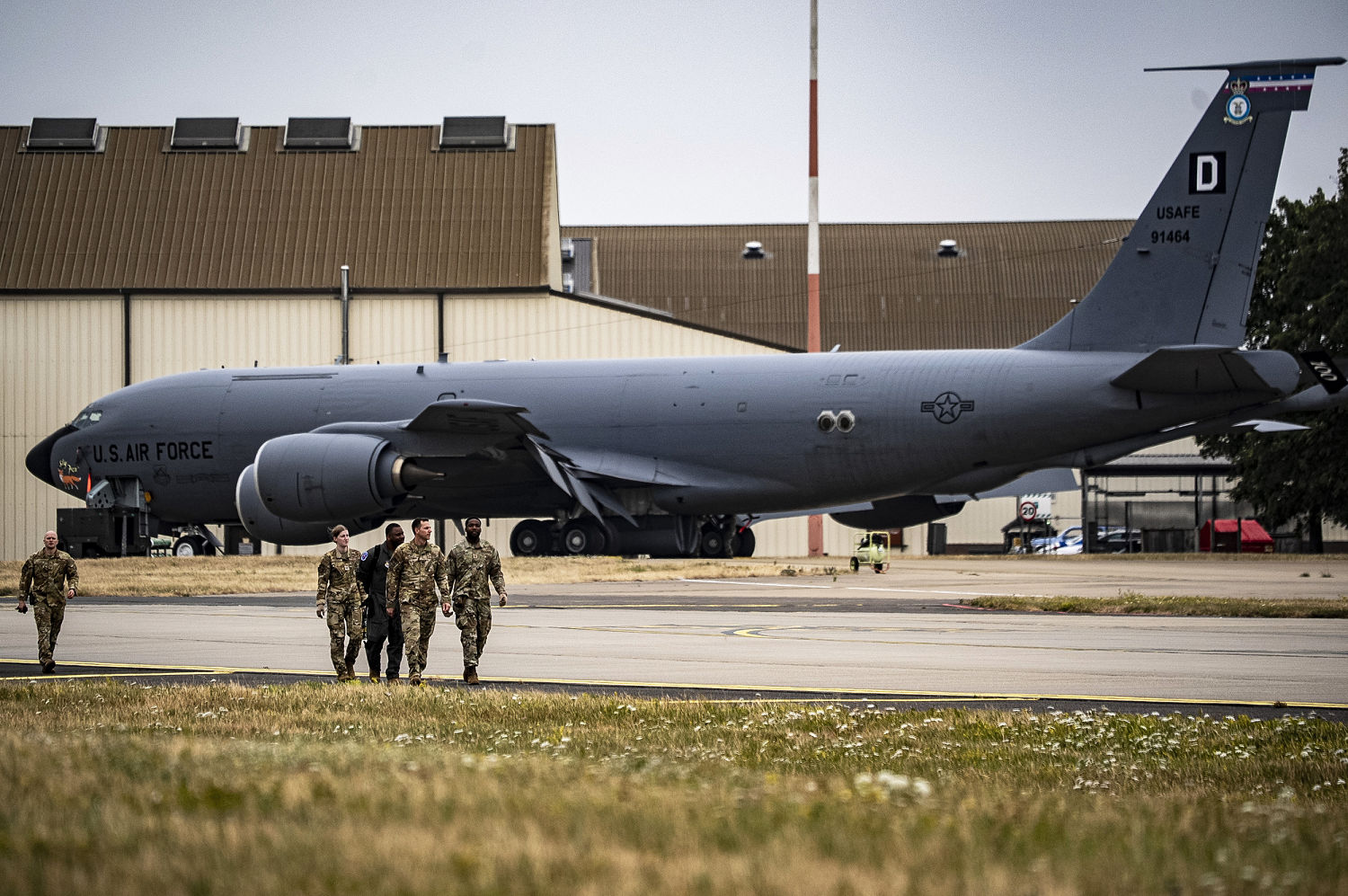
Flight trackers lit up like a Christmas tree over East Anglia recently, and suddenly social media was convinced World War III had started in Suffolk. When reports surfaced that the US Air Force was pulling aircraft out of RAF Mildenhall due to an Iranian threat, panic spread faster than actual facts.
Here's the truth. Dispersing high-value military assets isn't a sign of impending doom or retreat. It's standard operating procedure when threat intelligence spikes, and honestly, the internet's reaction shows how little most commentators understand about modern air base logistics.
If you've ever watched open-source intelligence (OSINT) accounts track military transponders on platforms like ADS-B Exchange, you know how easily routine tactical shifts get blown out of proportion. Seeing a line of KC-135 Stratotankers or RC-135 reconnaissance planes suddenly leave a primary hub looks dramatic on a radar map. Yet for planners inside the Pentagon and the UK Ministry of Defence, moving planes out of a crowded airfield is basic survival math.
Why RAF Mildenhall Is Always in the Crosshairs
To understand why an evacuation or dispersal order happens here, you have to look at what RAF Mildenhall actually does. Located in Suffolk, England, it isn't a traditional fighter base screaming with F-35s every morning. It's a logistics and intelligence powerhouse.
Mildenhall hosts the 100th Air Refueling Wing, the only permanent US air refueling wing in Europe. Without those KC-135 tankers, long-range bombers and fighter jets flying between the US, Europe, and the Middle East simply run out of gas. It also houses the 352d Special Operations Wing and serves as a critical staging ground for RC-135 Rivet Joint reconnaissance aircraft.
Because so many irreplaceable support planes sit on one stretch of tarmac, Mildenhall is what military strategists call a high-value target. Putting all your tankers and spy planes on one predictable runway makes life way too easy for an adversary.
When intelligence agencies pick up chatter about potential asymmetric attacks—whether from Iranian-backed proxies, long-range one-way attack drones, or sabotage cells operating in Europe—leaving hundreds of millions of dollars of unarmored refueling aircraft parked wingtip-to-wingtip is reckless.
What Actually Happens During a Threat Dispersal
Media headlines love the word "evacuation." It sounds frantic. People picture pilots sprinting across the tarmac in the middle of the night while sirens wail.
The reality is far more calculated. In Air Force doctrine, this falls under Agile Combat Employment (ACE). Instead of operating out of massive, vulnerable mega-bases, commanders split aircraft up and send them to smaller, dispersed airfields across allied territory.
When an elevated threat warning hits RAF Mildenhall, three things happen almost immediately:
- High-value tankers and ISR (Intelligence, Surveillance, and Reconnaissance) planes launch and relocate to secondary bases in the UK, Germany, or further south in the Mediterranean.
- Ground security tightens around the perimeter, often involving British Ministry of Defence Police working alongside US Air Force Security Forces.
- Non-essential flightline operations pause while threat assessments get updated hour by hour.
Notice what isn't happening. Nobody is abandoning the base. The infrastructure stays intact, the command centers keep humming, and the planes remain fully operational—just parked somewhere an attacker didn't expect.
The Iran Connection and Long-Range Reach
Why would a base in the quiet English countryside worry about Iran? Geography used to protect bases in Western Europe from Middle Eastern conflicts. Those days are gone.
Iran has spent the last decade building an extensive network of proxy militias and investing heavily in long-range unmanned aerial vehicles (UAVs) and ballistic missiles. Even more concerning for European bases is the threat of covert sabotage or localized drone launches near airfields.
You don't need an intercontinental ballistic missile to ruin an Air Force wing's week. A few commercial-grade drones modified with explosives, launched from a van three miles outside the perimeter fence in Suffolk, could puncture fuel bladders and ground an entire fleet of KC-135 tankers. Security officials across the UK and Germany have been openly warning about drone incursions near military installations for years.
During periods of heightened Middle East tension—such as direct exchanges of missile fire between Iran and Israel or US strikes on Houthi and Iranian-aligned targets—US European Command (EUCOM) automatically raises force protection levels. Because Mildenhall acts as the gas station for missions heading toward the CENTCOM area of responsibility, it becomes a direct link in the kill chain. That makes it a legitimate target in Tehran's eyes.
Stop Confusing OSINT Noise With Official Strategy
If you want to follow military aviation news without falling for clickbait, you need to filter how you consume information. Right now, the biggest problem in defense reporting is the gap between raw flight-tracking data and actual intelligence.
Anyone with an internet connection can watch military aircraft turn on their ADS-B transponders over the North Sea. When three or four tankers take off within twenty minutes of each other, Twitter accounts immediately scream about an "emergency evacuation."
Sometimes, those mass departures are literally just scheduled weather evasions—moving planes out of the path of a severe Atlantic storm rolling across Britain. Other times, they're pre-planned readiness exercises designed to test how fast crews can scramble. And yes, occasionally, they're genuine threat dispersals triggered by classified intelligence.
Here's how you can tell the difference next time a headline breaks:
- Check the transponder patterns. During genuine high-threat movements, military aircraft often switch off public ADS-B tracking shortly after takeoff, relying instead on military Mode 5 IFF systems that public trackers can't see. If you can watch the whole flight path neatly land at another base on Flightradar24, it's probably routine.
- Look at neighboring RAF Lakenheath. Lakenheath sits just a few miles away from Mildenhall and houses F-15E Strike Eagles and F-35A Lightning IIs. If Mildenhall is dispersing tankers due to an imminent physical attack on East Anglia, you'll almost certainly see unusual defensive combat air patrols or matching movements out of Lakenheath.
- Wait for the NOTAMs. Notices to Air Missions (NOTAMs) issued by aviation authorities often reveal temporary airspace restrictions or runway closures hours before mainstream news outlets catch on.
The Bigger Picture for UK and US Defense
Moving aircraft out of RAF Mildenhall over an Iran threat highlights an uncomfortable truth for Western militaries. For thirty years after the Cold War, the US and UK operated under the assumption that bases in Britain were safe sanctuaries. Security budgets shrank, hardened aircraft shelters weren't built for massive tankers, and operations became heavily centralized to save money.
Now, that efficiency has become a liability. Adversaries know that destroying five tankers in Suffolk can stall an entire air campaign four thousand miles away.
Expect to see a lot more of these sudden aircraft movements in the coming months. As long as tensions between Washington and Tehran simmer, bases like RAF Mildenhall won't sit still. Watch the flight trackers if you enjoy aviation, keep a healthy skepticism toward viral panic threads, and recognize that a moving fleet is simply a fleet doing its job to stay alive.