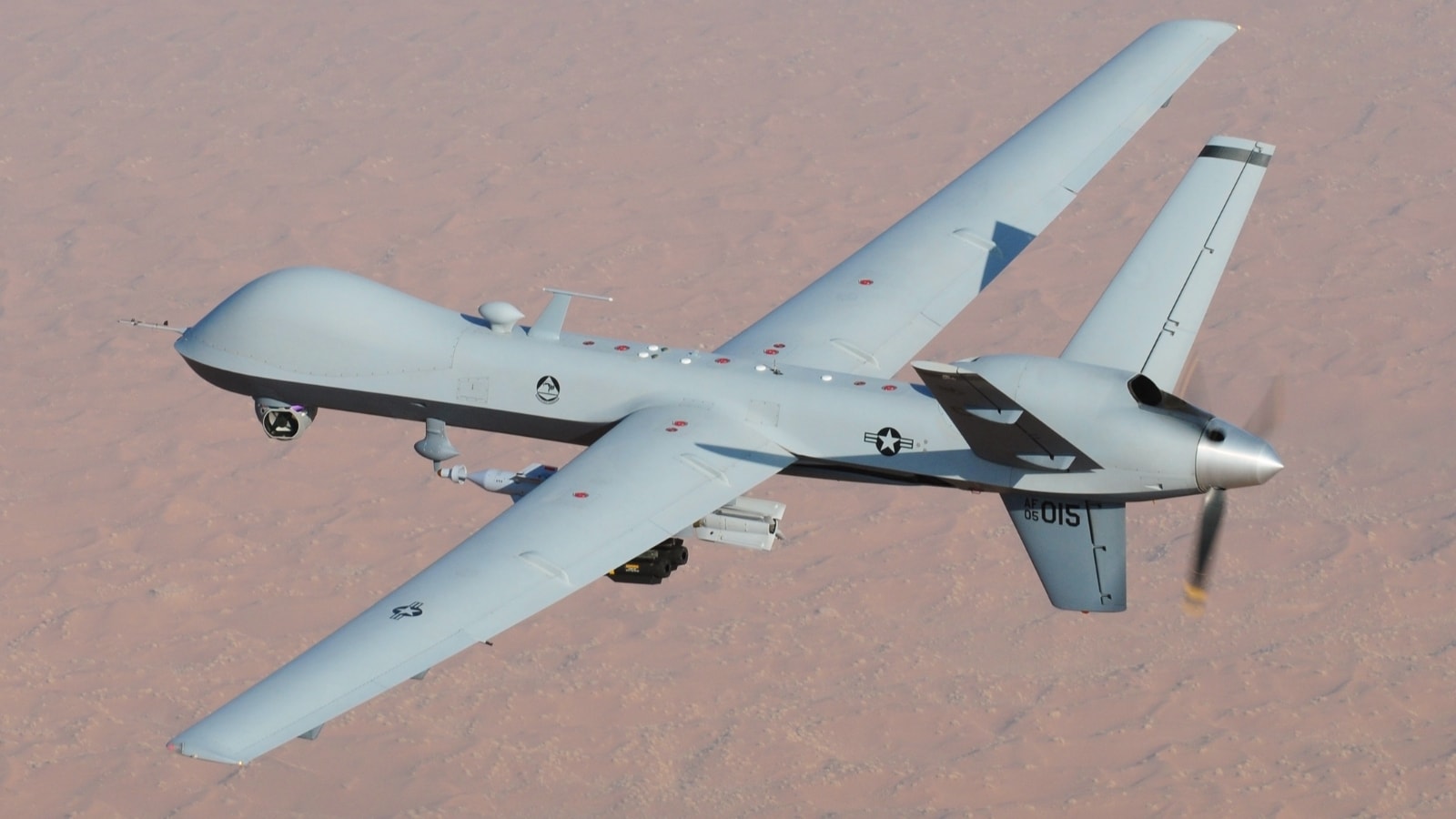
The desert floor does not keep secrets for long. The wind strips away paint, scours metal, and leaves behind the bleached skeletons of things that were once meant to fly forever.
Ask anyone who has spent a decade staring at a green-tinted monitor in a windowless room thousands of miles away from the smell of cordite. They will tell you about the hum of the cooling fans. They will tell you about the strange, shifting intimacy of watching a village wake up on a high-definition screen while sitting in a climate-controlled container in the Nevada desert.
Then, they will tell you about the silence when the feed cuts out.
Numbers on a spreadsheet rarely bleed. We are told that forty-five is just a statistic. Forty-five MQ-9 Reaper drones lost in the crucible of the Iran conflict. Forty-five multi-million-dollar apex predators of the modern surveillance state, tumbling out of a Persian sky or burning on foreign tarmac. To a quartermaster, it is a line item. To an accountant in the Pentagon, it is a budget adjustment.
(Note: All figures regarding drone losses are derived from official defense assessments and verified operational reporting.)
Let us step inside a ground control station for a moment. This is a hypothetical scenario, constructed from the documented reality of thousands of flight hours.
The sensor operator's fingers are cramped. They have been locked on a thermal signature for six hours. The air conditioning in the trailer is struggling against the desert heat outside, just as the turbine inside the aircraft thirty thousand feet above a hostile border is screaming to maintain lift in thin, turbulent air.
Then comes the warning tone. It is not a dramatic klaxon. It is a polite, insistent beep.
A surface-to-air missile, guided by radar networks that have grown sharper and smarter over years of constant cat-and-mouse games, has found the frequency. The Reaper is not invisible. In the grand architecture of modern aerial warfare, true invisibility is a myth we tell ourselves to justify the price tags. The Reaper is merely persistent. Until it isn't.
For a few seconds, the sensor operator watches the telemetry collapse. Altitude: dropping. Airspeed: zero. Signal: lost.
And then, static. Millions of dollars of composite fiber, high-resolution optics, and classified software vaporized in a fraction of a second. The crew takes off their headsets. They walk out into the blinding Nevada sun. Across the world, a smoking crater cools in the dust.
We built these machines because we wanted to keep our sons and daughters out of harm's way. That was the grand promise of the unmanned revolution. Take the pilot out of the cockpit, place them behind a desk with a coffee mug, and the moral calculus of war shifts. You can fight without bleeding. You can strike without mourning.
Except history has a crude way of breaking our promises.
War adapts. It always does. When you introduce a weapon that changes the math, the other side does not simply surrender; they solve the puzzle. The conflict with Iran did not happen in a vacuum. It was a laboratory of electronic warfare, where cheap, locally manufactured jammers met sophisticated GPS guidance systems, and where densely layered air defenses tested the limits of remote-piloted hulls that were originally designed for counter-insurgency skies, not contested, near-peer battlefields.
The MQ-9 was built for a world of absolute supremacy. It ruled the unblinking skies over Iraq and Afghanistan where nobody shot back with advanced radar. But when thrust into the teeth of a sophisticated, integrated defense network, the vulnerabilities became glaring. Size matters. Speed matters. A Reaper has a wingspan wider than a commercial airliner, yet it moves at the lazy speed of a turboprop. It is a magnificent platform for watching, but a sitting duck when the neighborhood turns hostile.
Consider what happens next: the realization that the era of the lumbering drone is drawing to a close.
Forty-five losses represent a profound institutional reckoning. It is not just about the hardware. It is about the philosophy of command. When you lose that many high-value assets, you are forced to ask whether the tool matches the terrain. You begin to look at swarms of disposable micro-drones. You look at artificial intelligence that can make split-second navigation decisions when the data link is jammed by enemy transmitters. You look at autonomy not as a luxury, but as a survival mechanism.
The human cost in these moments is quiet. It lives in the quiet fatigue of the analysts who process the footage, the engineers who redesign the routing algorithms, and the taxpayers who foot the bill for every smoking tailfin left in the sand.
We engineered ourselves into a corner of technological arrogance, believing that distance equaled safety, and that altitude equaled immunity. The desert has a way of reminding us that gravity applies to silicon just as easily as it does to flesh.
The screens go black. The maintenance crews pack their tools. And somewhere over the jagged peaks of the Middle East, the sky waits for the next machine to test its limits.