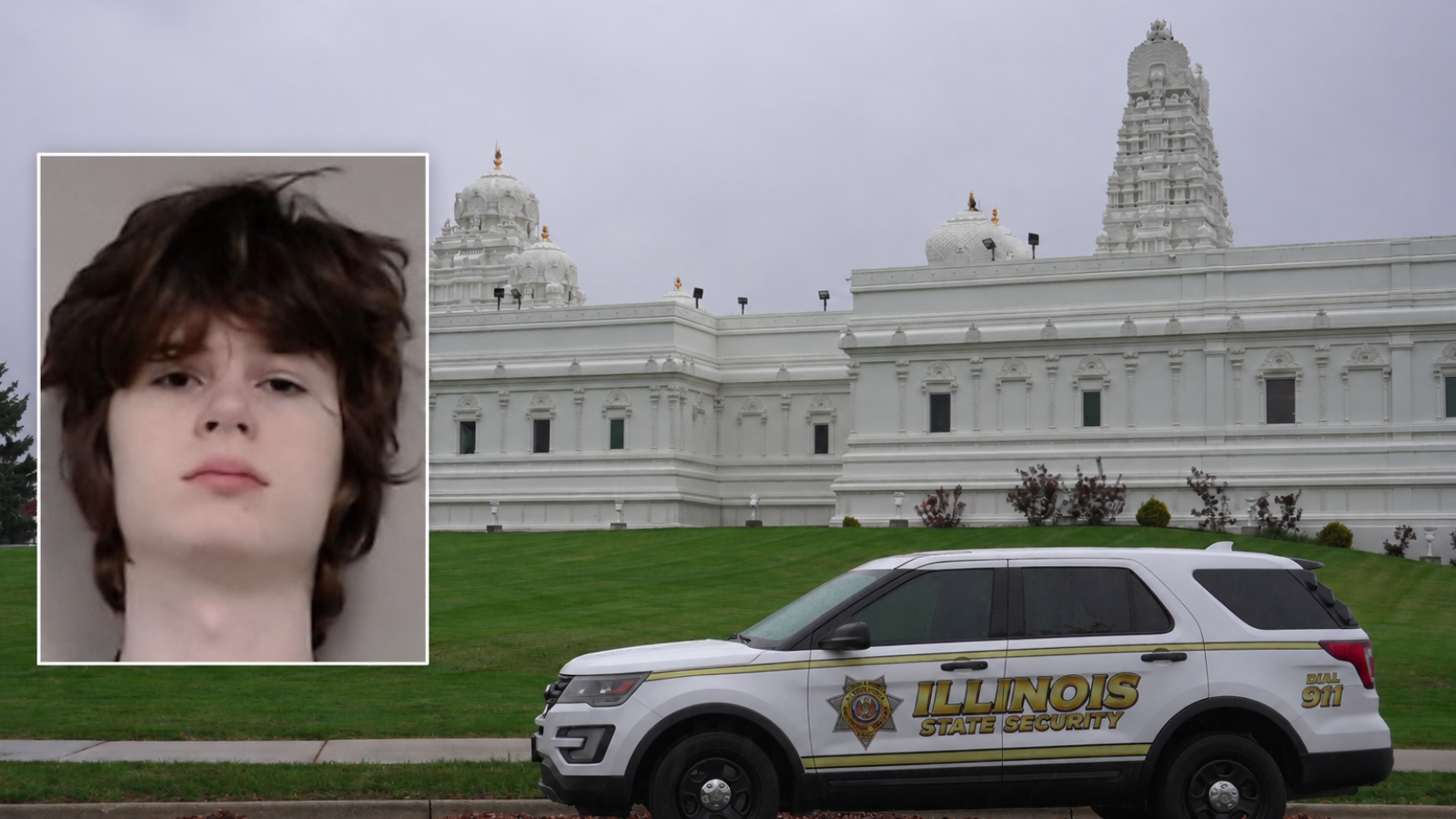
Brass bells. Sweet incense. The soft rustle of silk saris and linen kurtas settling onto cool stone or polished wood.
For millions of families, a Hindu temple is not just a place of worship. It is the living room of the diaspora. It is where a grandmother teaches a toddler how to fold tiny palms together in namaste, where college students homesick for Bengaluru or New Jersey come for a warm plate of prasad, and where elders sit on benches trading stories about their children's graduations and blood pressure readings.
Now picture a teenager in a quiet suburban bedroom scrolling through dark corners of the internet, collecting hatred like trading cards. Picture a Nazi patch tucked into a drawer. Picture three hundred rounds of ammunition waiting somewhere nearby.
Threat.
The word sits flat on a police report or a breaking news chyron. It looks neat. Bounded. Almost clinical. Yet behind every threat of an attack on a house of worship lies an earthquake of fear that travels outward in concentric rings, shaking people who never met the suspect and never walked past his front door.
I have stood inside temples on a Sunday morning when the air felt thinner than usual. Nobody announced anything. No siren went off. Still, you could see it in the way an uncle lingered near the entrance longer than he needed to, or how a mother kept her hand resting lightly on her son's shoulder while the priest chanted. When headlines speak of plots to kill Indian people, or threats aimed at a Hindu temple, the danger is never confined to the target alone. It spills into every grocery aisle, every school pickup line, every quiet moment of belonging a minority community has spent decades building.
Let's be clear about what we are dealing with and where the facts stand. Because this prompt gives only a headline and no verified case file or police report beyond that headline, I will treat the specific details mentioned in that headline—the reported words "kill Indian people," the plot targeting a US Hindu temple, the three hundred rounds of ammunition, and the Nazi patch found at a teenager's home—as the premise we are examining, while grounding the broader dynamics of extremism, radicalization, and community impact in well-established behavioral patterns and public safety realities. When I use a hypothetical scenario or a metaphor to illustrate how these forces operate, I will say so plainly.
How Hatred Learns To Wear Old Symbols
Extremism rarely arrives wearing a single label. It borrows.
Consider a metaphor: think of hate ideology like a scavenger bird. It does not build its own nest from scratch when it can steal twigs from a dozen abandoned ones. A teenager drawn into violent extremism today might absorb twentieth-century Nazi iconography alongside modern anti-immigrant slogans, racialized slurs, or online memes that strip real human beings of their faces and histories.
Why a Nazi patch? Historically, swastikas and SS runes have served as shorthand for total dehumanization—a signal that the wearer rejects shared civic life and views entire groups of people as subhuman or expendable. When that symbol shows up in the home of a young person plotting violence against a Hindu temple or targeting Indian people in the United States, it reveals a collision of old genocidal aesthetics with contemporary grievances.
It can feel baffling to outsiders. How does a teenager sitting miles away from a temple decide that people whose families celebrate Diwali, eat dosas, or pray to Ganesha represent an existential enemy?
Honestly, I do not think there is a single neat answer that makes it feel logical, because hatred itself is built on distortion. Radicalization online often works through repetition and isolation. Algorithms and extremist forums feed a person a steady diet of outrage until cruelty starts looking like courage and mass violence starts looking like a movie script.
To make this dynamic concrete, let us use a hypothetical scenario—clearly marked as fictional—to trace how a quiet household can miss the warning signs. Suppose a sixteen-year-old boy named Ethan spends hours every night behind a locked bedroom door. To his parents, he seems moody, distant, maybe glued to video games like half the kids on the block. They might notice a strange patch on a backpack or boxes of ammunition bought legally or acquired through risky channels, yet rationalize each piece separately. A patch is just edgy dark humor, they tell themselves. Target practice is normal in their state. Three hundred rounds sounds like a lot until someone convinces themselves it is cheaper to buy in bulk.
That rationalization is one of the most dangerous parts of modern radicalization. Warning signs rarely arrive with a neon sign flashing imminent attack. They show up in fragments. A comment in a chat room. A shift in vocabulary from arguing policy to wishing death on "Indian people." A fixation on weapons paired with contempt for anyone different.
The Weight Of Three Hundred Rounds
Numbers have a way of freezing time.
Three hundred rounds.
On paper, it is a figure that fits easily inside a sentence. In reality, it represents sustained intent. A single stray round can be an accident; three hundred rounds points toward planning, rehearsal, or an expectation of prolonged violence. Law enforcement investigators and counterterrorism analysts look closely at scale and specificity—not just vague anger, but concrete preparation and identifiable targets.
When a plot centers on a Hindu temple, the stakes carry a distinct cultural and historical weight. In the United States, Hindu Americans are often stereotyped through narrow lenses—as model minorities, tech workers, doctors, or quiet neighbors who keep their heads down and stay out of trouble. That stereotype is inaccurate on its own, flattening millions of diverse individuals from different states, languages, castes, and backgrounds into a single caricature. Worse, it creates a false sense of security. People assume that if a community is prosperous or peaceful, nobody would ever turn violent against it.
History proves otherwise. Targets of hate-motivated violence are chosen less for what they actually do and more for what an attacker projects onto them. During periods of economic anxiety, cultural polarization, or political scapegoating, immigrant and minority communities frequently become lightning rods. Language matters here. When rhetoric online or offline reduces complex human beings to phrases like "Indian people" in a hostile context, it erases individuality. It turns neighbors into targets.
I remember talking with a community organizer years ago after a scare near a place of worship. He said something that has stayed with me ever since: "The hardest part isn't the day the police show up. It's the Tuesday two weeks later when someone asks whether we should lock the side gate during evening aarti."
Security changes the atmosphere of a sacred space. Nobody builds a mandir wanting metal detectors, armed guards, or nervous glances toward the parking lot. Sacred spaces are supposed to lower a person's guard, not raise it. Yet when threats surface—especially ones involving ammunition and extremist symbols—leaders and congregants are forced into a painful trade-off between openness and protection.
Why Communities Feel The Shockwaves Long After Headlines Fade
News cycles move at sprint speed. A shocking headline spikes, circulates for forty-eight hours, and gets replaced by the next crisis.
For the people inside the community, the timeline is completely different. Trauma does not run on an algorithm.
Let's look at what happens in the days and weeks after a plot is uncovered before an attack occurs. Even when law enforcement intervenes in time—and timely intervention is something to be profoundly grateful for when it succeeds—the emotional aftermath lingers.
First comes disbelief. Parents wonder how a teenager could harbor such lethal hostility. Neighbors look at a quiet street and ask who was really living next door. Temple board members review security cameras, emergency exits, and communication trees with a knot in their stomachs.
Then comes vigilance. Every unfamiliar car idling near the temple driveway draws a second look. Every loud bang outside triggers a brief, involuntary flinch. For young people growing up in diaspora communities, hearing that someone wanted to kill people who look like them or share their heritage can leave a quiet bruise on their sense of safety in the country they call home.
Some people respond by pulling inward. They skip gatherings, keep their kids home, or avoid speaking about their faith in public spaces. Others lean forward, organizing interfaith vigils, checking in on elders, and demanding clear accountability from institutions and tech platforms.
Both reactions are human. Fear makes us want walls; solidarity makes us look for bridges.
Separating Fact From Fear Without Looking Away
One of the hardest balances in covering or discussing extremism is staying clear-eyed without feeding panic.
Overreacting can distort reality just as much as ignoring danger. When a story involves a Nazi patch, a teenager, and three hundred rounds of ammunition, our brains naturally jump to worst-case movies. We imagine armies of extremists around every corner. In reality, violent plots often involve deeply troubled or radicalized individuals operating in toxic digital echo chambers, alongside networks or enablers that investigators must untangle carefully.
At the same time, underreacting is a luxury communities targeted by hate cannot afford. Dismissing a threat just because a plot was thwarted—or because a suspect is young—misses how early radicalization can turn lethal if left unchecked.
So how do families, communities, and civic institutions respond in a way that is grounded rather than hysterical?
Start with honest conversation at home. Parents across every background need to know what their kids are watching, playing, and reading online. Extremist grooming rarely looks like a stranger in a trench coat; it often looks like gaming banter, edgy memes, or grievances dressed up as humor. Asking questions early—without immediately blowing up—can open a door before that door locks for good.
Next, invest in practical community preparedness that preserves warmth rather than erasing it. Clear emergency plans, trained volunteers, strong relationships with local law enforcement, and open communication among faith leaders help turn anxiety into readiness. Preparedness is not paranoia when it is calm, measured, and shared.
Finally, refuse to let dehumanizing language go unchallenged. Words are the dry grass; ideologies are the spark. When people start talking about any group in terms of collective blame or existential threat, the distance between speech and violence shrinks. Naming hate plainly—whether it carries a swastika, an anti-Indian slur, or any other banner—keeps moral boundaries intact.
What Remains When The Noise Dies Down
Evening falls over a neighborhood temple. The lamps flicker softly inside the sanctuary, casting warm gold against carved stone and quiet walls.
Outside, life goes on. Cars pass on the main road. Somewhere a dog barks. A teenager upstairs in another house turns off a monitor, leaving behind a glow in the dark that no screen can truly illuminate.
A plot stopped in time is a story that never reached its worst chapter—and that mercy matters. Yet the real test of a society shows up in what happens next: whether fear shrinks our circles of care, or whether we stand guard over one another's right to gather in peace without looking over our shoulders.
A prayer whispered in safety is a fragile thing. Keep it whole.


