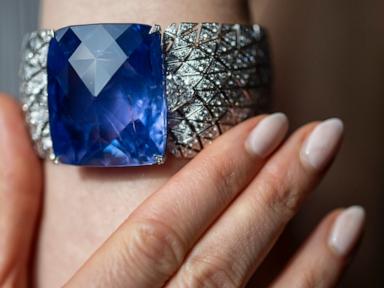
Four point nine million dollars. That's what a single piece of imperial Russian history just fetched on the auction block in Geneva, proving once again that royal provenance makes wealthy collectors lose all sense of restraint.
You might think a bracelet selling for nearly five million bucks is just another Tuesday in the ultra-luxury market. It isn't. When a Romanov sapphire bracelet commands $4.9 million at a Geneva auction, it signals something much deeper about how billionaires store wealth, how surviving imperial jewels carry mythical status, and why Burmese sapphires are outperforming almost every traditional asset class right now.
Let's break down what actually happened in that Geneva salesroom, why this specific bracelet drove bidders into a frenzy, and what it means if you're tracking the high-end jewelry and alternative asset markets.
What Made This Romanov Sapphire Bracelet So Special
Not every piece of antique jewelry gets the royal treatment. Plenty of 19th-century diamond and gemstone pieces cross the block in Switzerland every May and November and quietly sell for fifty or a hundred grand. So why did this one hit $4.9 million?
It comes down to three things: the stones, the craftsmanship, and the bloodline.
First, let's talk about the sapphires themselves. In the world of colored gemstones, origin is everything. A sapphire from Sri Lanka or Madagascar might look gorgeous to the naked eye, yet it will never touch the price per carat of a stone pulled from the Mogok Valley in Burma (modern-day Myanmar). Historic Romanov pieces almost exclusively feature unheated Burmese sapphires known for that rich, velvety "royal blue" hue that holds its color even under dim candlelight. Modern mines simply don't produce stones with that exact saturation anymore.
Second, you have the Romanov name. When the Russian Imperial family fell during the 1917 revolution, much of their legendary treasure was either confiscated by the Bolsheviks, broken up and sold off for hard currency in the 1920s, or smuggled out of the country sewn into the linings of coats by fleeing aristocrats. Because so much of the imperial collection was destroyed or dispersed, any intact jewel with documented Romanov provenance becomes an instant museum-grade artifact.
Collectors aren't just buying metal and rocks here. They're buying survival. They're holding a physical object that escaped one of the most violent political upheavals of the twentieth century.
The Geneva Auction Effect
Why Geneva? If you follow high-stakes art and jewelry, you know New York dominates contemporary art, London owns old masters and classic cars, and Geneva is the undisputed capital of rare gems and watches.
Auction houses like Sotheby's and Christie's hold their flagship Magnificent Jewels sales in Geneva twice a year for a very specific reason. Switzerland offers discreet banking, favorable customs rules for high-value portable goods, and a concentration of private wealth you won't find anywhere else on earth. When a headline piece like a Romanov sapphire bracelet hits the Geneva rostrum, the biggest private buyers from the Middle East, Asia, and Europe are either in the room or on the phone with their specialists.
I've watched these Geneva sales for years, and the psychology in the room is fascinating. Once bidding passes the two-million-dollar mark, logic leaves the building. Two or three anonymous telephone bidders—usually represented by senior jewelry specialists sitting at the side of the room—start trading increments of $100,000 or $200,000 like they're tossing poker chips. Nobody wants to be the person who let a once-in-a-lifetime royal piece slip away over a few hundred thousand francs.
Why Royal Provenance Multiplies Value
If you stripped the Romanov history away from this bracelet and sold it purely on the weight of its sapphires and diamonds, what would it be worth? Honestly, probably a fraction of the $4.9 million final price.
In the secondary jewelry market, dealers talk about the "provenance premium." A standard Art Deco or Belle Époque sapphire bracelet of similar carat weight might sell for $400,000 to $800,000 depending on stone quality. Attach a verifiable link to a Grand Duchess or an Empress of Russia, and you can easily multiply that valuation by five or ten times.
We've seen this pattern play out repeatedly over the last decade. Think about Marie Antoinette's natural pearl and diamond pendant, which blew past its $1 million to $2 million estimate at Sotheby's Geneva in 2018 to sell for an astonishing $36 million. Or look at the Fabergé winter egg and other imperial Russian works of art that routinely shatter world records whenever they resurface from private collections.
Provenance acts as an insurance policy against market downturns. Standard luxury goods lose value the second you walk out of the boutique. Historic royal jewels do the exact opposite because the supply is permanently frozen. Nobody is making new 19th-century Romanov bracelets.
How Collectors Verify Imperial Russian Jewels
Here is something most casual readers don't realize: the antique market is flooded with fake royal stories. Every third dealer at an antique fair claims a brooch belonged to a Russian princess or a French countess. Without paperwork, those stories are worth zero.
To command $4.9 million at a major Geneva auction house, a piece has to survive brutal scrutiny from historians, gemologists, and archival researchers. Specialists look for several hard proofs before they ever print the Romanov name in a catalog:
- Maker's marks and Russian hallmarks: Pre-1917 Russian jewelry carries very specific Kokoshnik assay marks showing silver or gold purity alongside the city mark (like St. Petersburg or Moscow) and the workmaster's initials. Houses like Bolin, Hahn, and Fabergé had distinct construction techniques that experts can spot under a loupe.
- Archival photographs and portraits: Researchers scour black-and-white court portraits from the late 1800s and early 1900s. Russian Grand Duchesses loved being photographed in full court dress dripping in jewels, and magnifying those old glass-plate negatives often reveals the exact silhouette of a surviving bracelet or tiara.
- Inventory ledgers and export records: After the revolution, the Soviet Gokhran (State Depository for Valuables) cataloged thousands of seized items before selling them to Western dealers like Norman Weiss or Armand Hammer. Matching a piece to those inventory descriptions locks in its history.
- Independent gemological reports: Labs like the Swiss Gemmological Institute (SSEF) or Gübelin issue detailed dossiers confirming the sapphires are natural, unheated, and of Burmese origin.
Without that paper trail, a $4.9 million sale simply doesn't happen. Serious buyers demand airtight proof before wiring seven figures.
What Most People Get Wrong About High-End Jewelry Auctions
People love to treat these headline sales as pure vanity purchases by out-of-touch billionaires. That's a massive misconception.
While ego definitely plays a role when two rivals bid against each other, ultra-high-net-worth buyers treat rare colored gemstones and royal jewels as portable, inflation-hedged hard assets. You can't easily fold a $5 million painting into a carry-on bag and fly across borders, and real estate comes with property taxes, maintenance headaches, and government visibility. A sapphire bracelet fits in a coat pocket.
Over the past twenty years, top-tier unheated Burmese sapphires, Kashmir sapphires, and Burmese rubies have quietly outperformed gold and many equity indices. Because mine production for top-grade stones has essentially dried up while global billionaire wealth has expanded, supply and demand are completely out of balance.
Another common myth is that the final hammer price is what the buyer actually pays. When an auction house announces a $4.9 million result, that figure includes the buyer's premium—a hefty commission (often around 20% to 26% on the first tier, stepping down at higher thresholds) that goes straight to the auction house on top of the final bid. Depending on where the buyer takes delivery, Swiss VAT or local import duties might also apply.
What You Should Watch Next in the Jewelry Market
If you're fascinated by these record-breaking sales—or if you're building your own collection at a more realistic price point—pay close attention to what happens right after a headline sale like this one.
First, expect more hidden Romanov and European aristocratic pieces to emerge over the next twelve to eighteen months. Whenever a single piece hits $4.9 million, private families sitting on inherited vaults take notice. Auction specialists are already working the phones right now, pitching owners of similar 19th-century sapphires to consign for the next Geneva cycle.
Second, watch the ripple effect on non-royal antique sapphires. When the top of the market spikes, collectors who got priced out of the $4.9 million trophy piece start hunting for unsigned Belle Époque or Edwardian sapphire bracelets in the $30,000 to $150,000 range. That secondary wave lifts prices across the entire category.
If you ever plan to buy antique colored gemstones yourself, take a page straight from the Geneva playbook. Always insist on a major lab certificate (SSEF, Gübelin, or GIA) before buying any sapphire over a couple of carats, prioritize unheated stones over heat-treated ones, and never pay extra for a "royal story" unless the seller hands you documented proof in writing.