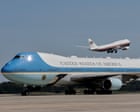
There is a specific, heavy hum inside the belly of a Boeing 747 or 757 when the engines first spool up for takeoff on the tarmac of Joint Base Andrews. It vibrates through the soles of your shoes. It rattles the loose change in your pocket. For the journalists who have spent decades covering the executive branch of the United States government, that sound is the metronome of their professional lives.
You board through the rear stairs. You stow your gear in the cramped overhead bins designated for the press pool. You strap into seats that are comfortable enough, though significantly less plush than the mahogany-trimmed quarters reserved for the commander-in-chief, the chief of staff, and a rotating cast of cabinet officials and senior advisors up front. Expanding on this topic, you can find more in: The Constitutional Battle Behind the White House Strategy to Claw Back Federal Spending.
Distance matters in politics. Physical proximity is power, and the back of Air Force One has always been a subtle reminder of the journalistic bargain: we carry your luggage, we pay our way, we sit within shouting distance of history, and in exchange, we bear witness.
Then, the door closes. And sometimes, the door stays shut. Experts at Reuters have provided expertise on this trend.
The recent decision by the White House to block CNN from a seat on Air Force One during a trip is not merely a scheduling dispute or a petty administrative spat over seat assignments. It is a fracture line in an old, fragile architecture. It is a moment that forces anyone who cares about how power is checked in a democracy to ask a fundamental question: what happens when the lens through which we view our leaders becomes a bargaining chip?
To understand why a single empty seat matters, you have to understand the geography of the flying Oval Office.
Air Force One is not just an airplane; it is a moving symbol of American continuity, sovereignty, and transparency. When a president travels abroad to negotiate treaties, calm panicked allies, or project strength in volatile regions, a phalanx of reporters travels right behind them. This is the press pool. It is a rotating collective representing wire services, television networks, print journalism, and radio.
They are the designated eyes and ears of the American public. They are the ones who can look out the window when the plane lands in a war-torn capital and report whether the local security forces look panicked or composed. They are the ones who can walk to the back of the aircraft, knock on the cabin door, and ask the press secretary an unscripted question at 35,000 feet.
When a news organization is barred from that flight, the public loses something invisible but irreplaceable: immediate, unfiltered context.
Consider what happens when a president travels without a full, independent press pool. The narrative of the trip shifts from independent observation to curated presentation. Official transcripts replace eyewitness accounts. Handpicked promotional clips replace spontaneous questioning in the aisle.
Governments—regardless of which party holds the keys—are inherently bureaucratic engines designed to protect their own reputations. They prefer the polished highlight reel to the messy, unscripted reality. Journalism exists to disrupt that preference. It is the grit in the gears.
The friction between journalists and presidents is as old as the republic itself. Thomas Jefferson despised the partisan press of his era with a white-hot intensity, writing that the man who reads nothing at all is better educated than the man who reads only newspapers. Yet Jefferson, like every modern president who followed him, ultimately recognized that a free press was the price of admission for leading a free society.
Over the decades, that uneasy truce settled into protocols. The White House Correspondents' Association manages the logistics of the press pool with meticulous, almost military precision. Seats are paid for by the news organizations at commercial first-class rates. Costs are shared. Rules are enforced. It is a system built on institutional habit and mutual necessity.
When those habits break down, they rarely do so with a thunderclap. They erode quietly, one blocked seat, one excluded briefing, one retaliatory snub at a time.
Imagine for a moment a hypothetical newsroom on a Tuesday afternoon. Editors are staring at breaking alerts from Washington. A major international crisis is unfolding. The president is boarding the plane for an unannounced emergency summit. The logistics desk is frantically dialing contacts at the press office, trying to secure clearance for their senior White House correspondent.
The response comes back flat and clinical: there is no room. Or worse, silence.
The impact of that silence ripples outward. Without a correspondent on board, the network must rely on pooled reports filed by competitors or official readouts provided by the administration's communications team. The edge is dulled. The questions asked are someone else's questions. The details noticed are someone else's details.
This is the hidden cost of media exclusion. It is not just that a corporation loses access or a reporter misses out on a dateline. It is that the collective memory of the nation becomes slightly more uniform, slightly more managed, and slightly less honest.
Power hates an audience that talks back. In recent years, the relationship between political administrations and the media has degraded from aggressive skepticism into outright tribal warfare. Both sides have found profit and political energy in the conflict. For politicians, attacking the press rallies a base that has grown deeply distrustful of mainstream institutions. For media outlets, framing coverage as a heroic defense of democracy drives subscriptions and viewership.
Everyone has a stake in the theater of hostility.
Yet beneath the performative outrage on cable news panels and social media feeds lies a quieter, more corrosive reality. Most Americans are exhausted by the friction. They do not wake up wondering which network got bumped from a flight; they wake up worrying about grocery prices, mortgage rates, and whether the world will be safer tomorrow than it was yesterday.
They look at the bickering between the podium and the press bench and see a symptom of a larger, systemic breakdown. They see two institutions that are supposed to serve the public interest spending too much time fighting over who gets to narrate the decline.
The airplane keeps flying. The engines roar over oceans and mountain ranges, carrying the most powerful person on Earth to destinations that will shape the history books.
Up front, decisions are made that affect millions of lives. In the middle, advisors crunch data and draft talking points. And in the back, where the seats are slightly tighter and the coffee pot is always empty, the empty space where a reporter should be remains a silent witness to a shrinking room for dissent.
Democracy requires physical spaces where opposing forces are forced to sit next to each other. When we stop sharing the same plane, when we stop listening to the same unvarnished questions, we stop living in the same reality.
The empty seat on Air Force One is a warning light on the dashboard. It tells us that the distance between the governed and the governors is widening, measured not in miles, but in access, trust, and truth.
And as the aircraft dips below the clouds on its final descent, the lights of the capital city flicker up through the windows—bright, complex, and watching closely to see who made the trip.