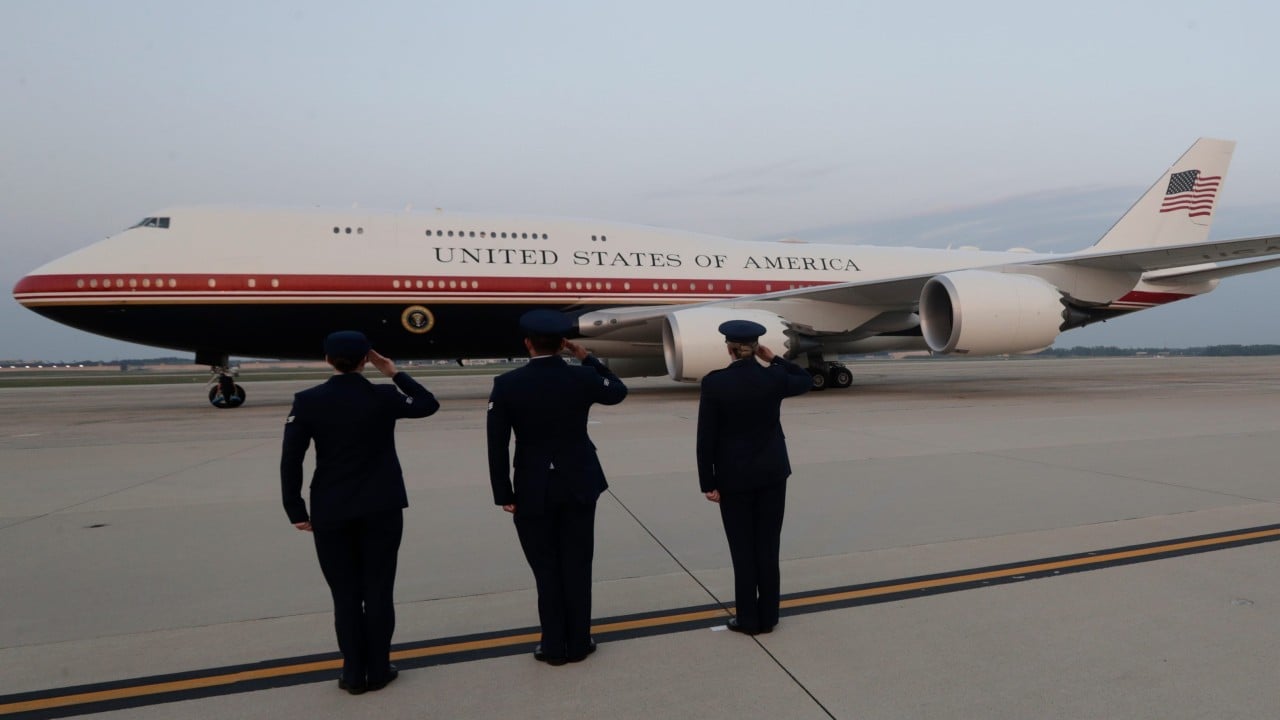
The air inside the hangar is always cold, tasting faintly of aviation fuel and ionized dust. When you stand beneath the belly of a modified Boeing 747-8, the sheer scale of the machine doesn't just catch your eye; it presses against your chest. This isn't just an airplane. It is a flying fortress, a symbol of national sovereignty, and, in the darkest scenarios envisioned by military strategists, the ultimate lifeboat.
For decades, the call sign Air Force One has evoked images of presidential luxury—plush leather seats, mahogany conference tables, and the distinctive blue-and-white livery slicing through the sky. But behind the veneer of diplomatic comfort lies a brutal engineering reality. The sky is no longer a safe haven. The modernization of the next-generation presidential aircraft, known militarily as the VC-25B, has quietly shifted from a project focused on state-of-the-art communications to a desperate race against modern physics and lethal weaponry.
They are maxing it out. Every square inch of the airframe is being stuffed with defensive countermeasures, driven by a growing, claustrophobic fear of what awaits in the upper atmosphere.
The Mirage of the Safe Horizon
Consider a hypothetical scenario, the kind that keeps operators awake at three in the morning inside the Pentagon’s National Military Command Center.
The year is uncertain, but the geometry of the threat is terrifyingly current. The president is airborne over the Atlantic. Thousands of miles away, a geopolitical flashpoint erupts. A rogue actor or a near-peer adversary launches a digital strike, quickly followed by kinetic hardware. Suddenly, the radar screen flashes. A surface-to-air missile, moving at five times the speed of sound, is hunting the heat signature of four massive General Electric GEnx engines.
In the past, the vastness of the sky provided its own security. Not anymore.
Modern anti-aircraft systems and shoulder-fired missiles have evolved past simple heat-seeking tracking. They use multi-spectral seekers. They ignore basic flares. They see through standard radar chaff. To survive a modern airspace corridor, a giant, slow-moving commercial airliner converted into a command post cannot rely on speed or agility. It is a whale trying to dodge sharks.
The solution? Turn the whale into a porcupine.
The engineering teams tasked with upgrading the new fleet found themselves staring at a terrifying mandate. The threat matrix had mutated during the aircraft's lengthy development cycle. Hypersonic weapons, advanced electronic warfare jamming, and sophisticated laser-guided munitions meant the standard defensive suite was obsolete before the first coat of paint was applied.
Weapons of Light and Ghost Frequencies
To understand how you protect the most targeted individual on Earth, you have to stop thinking about armor plating. Heavy steel walls belong to tanks; they don't fly well. Instead, the new Air Force One relies on an invisible shield woven from electricity and light.
At the core of the new defensive push is the integration of Large Aircraft Infrared Countermeasures, or LAIRCM. Imagine a system that doesn't wait for a missile to get close. The moment a launch is detected by ultraviolet and infrared sensors puckered across the skin of the fuselage, the aircraft reacts automatically. Computers calculate the trajectory in milliseconds.
Then, a turret fires.
But it doesn't fire bullets. It fires a high-intensity, modulated laser beam directly into the eye of the incoming missile. The laser track blinds the weapon's guidance system, tricking it into thinking its target is miles away. The missile veers off into the empty ocean, chasing a ghost.
But what happens when the enemy isn't using heat tracking? What if they are painting the sky with high-frequency radar?
That is where the electronic warfare suite comes in. The belly of the aircraft is being packed with digital radio frequency memory jammers. These systems intercept enemy radar signals, manipulate them, and send them back to the source. To the enemy radar operator on the ground, the aircraft appears to disappear, or worse, appears to be in three places at once. It is a psychological shell game played at thirty thousand feet.
The Weight of Survival
Every system added demands power. Every laser turret requires wiring. Every sensor adds weight.
The engineering trade-offs are brutal. A standard Boeing 747-8 is designed to maximize passenger comfort and fuel efficiency for commercial airlines. When the U.S. Air Force strips the interior down to the bare aluminum ribs, they aren't just adding a kitchen or an office. They are installing miles of heavily shielded fiber-optic cables to withstand the electromagnetic pulse of a nuclear detonation.
They are adding heavy cooling systems to prevent the massive banks of computers from melting down during a cyber engagement.
This weight alters the very aerodynamics of the plane. It changes how it handles in turbulence. It reduces its maximum range. The cost overruns and delays that have plagued the project aren't merely the result of bureaucratic red tape; they are the consequence of trying to build a spaceship inside the shell of a passenger jet while the rules of engagement change daily.
We look at the skyrocketing price tag and see fiscal mismanagement. The engineers look at the threat data and see a mandatory insurance policy for the continuation of government.
The Long Ride Home
The true human element of Air Force One isn't the political figure waving from the top of the stairs. It is the flight crew, the communications officers, and the security detail who inhabit the belly of the beast. For them, the maximum protection upgrades aren't a political talking point. They are the thin line between an orderly transition of power and catastrophic failure.
If the worst happens, the people inside that aluminum tube will be entirely alone. They will be looking out the small, thick windows at a world descending into chaos below, relying on the automated systems buried deep within the wings to keep them alive for just one more hour.
The new paint job might look familiar, but underneath the skin, the machine is twitching with nervous energy, waiting for a threat it hopes will never come. The skies are getting darker, and the ultimate sanctuary has finally been forced to arm itself for the end of the world.