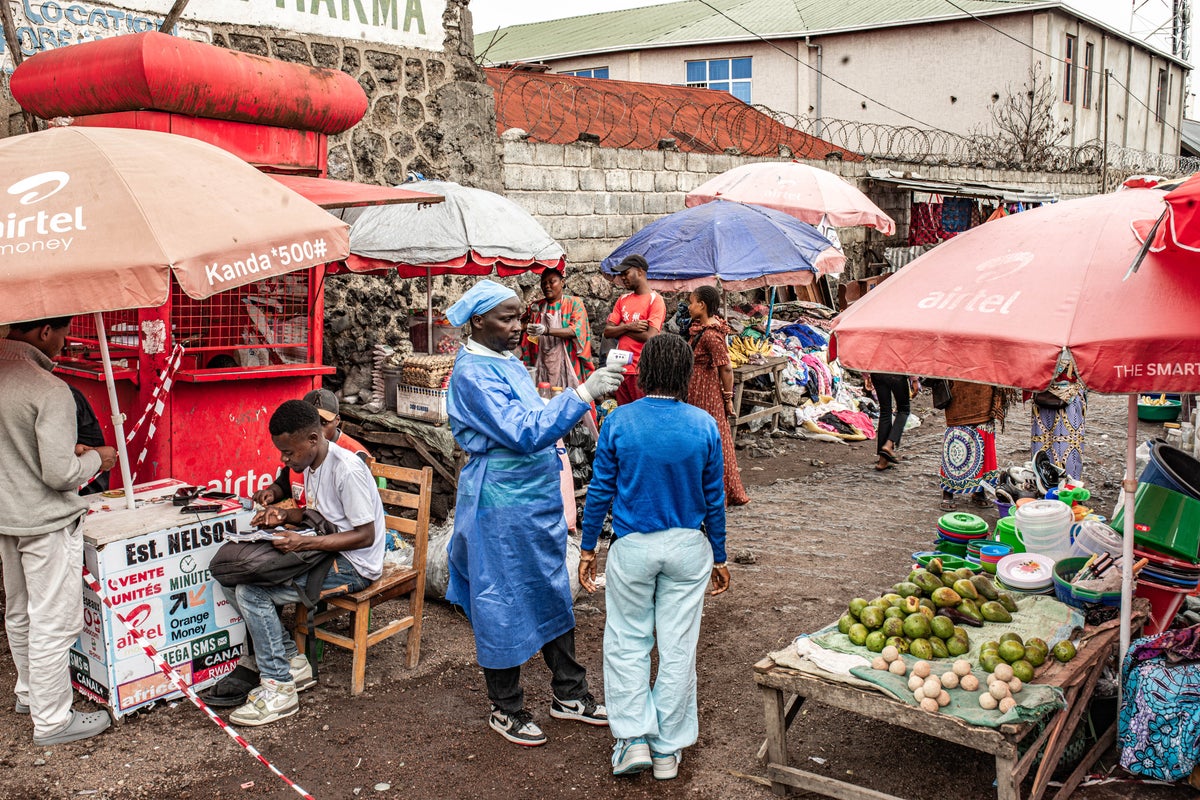
The international aid community is running its favorite playbook again. Following the Red Cross's pronouncement that the fast-spreading Ebola outbreak in the Democratic Republic of the Congo (DRC) is a direct reflection of "decades of development failure," western media outlets have fallen into line. They drone on about a lack of paved roads, missing electrical grids, and a shortage of Western-style clinics.
It is a comfortable, lazy narrative. It satisfies the donor class, justifies the existence of multi-billion-dollar NGOs, and completely misses the biological and sociological reality on the ground.
Blaming "development failure" for Ebola transmission is not just historically inaccurate; it is structurally blind. Ebola is not cholera. It does not spread because a village lacks PVC water pipes or a modern sewage treatment plant. It spreads because of highly specific, localized biological transmissions, deeply rooted cultural funerary practices, and—most importantly—the direct, destabilizing interventions of the aid apparatus itself.
If building roads and pouring concrete solved viral hemorrhagic fevers, the history of epidemiology would look entirely different. The hard truth nobody wants to admit is that standard Western "development" often accelerates outbreaks rather than stopping them.
The Density Paradox: Why Infrastructure Accelerates Infection
The foundational myth of global health is that infrastructure is an unalloyed good. "If only the DRC had paved highways," the argument goes, "we could ship vaccines faster."
Let us look at how viruses actually move. In the field of epidemiology, the basic reproduction number, or $R_0$, measures the transmissibility of an infectious agent. For Ebola, $R_0$ typically hovers between 1.5 and 2.0 in localized settings. It requires direct contact with bodily fluids: blood, vomit, sweat. It is a terrible, clumsy vector compared to airborne pathogens like measles or influenza.
Because Ebola kills its host with brutal speed—frequently within six to ten days—the virus faces an evolutionary bottleneck. In an isolated, undeveloped rainforest village, a spillover event from a fruit bat or non-human primate usually burns out naturally. The virus kills the primary host, infects a small handful of family members, runs out of susceptible bodies, and dies in the dirt. Isolation is the natural firewall.
What happens when you introduce classic economic development? You build a highway.
Suddenly, an infected individual in a remote area is no longer isolated by two days of foot travel. They are twelve hours away from a major urban transit hub via motorcycle taxi or regional bus. Paved infrastructure converts a self-limiting rural outbreak into an existential threat to cities of millions, like Goma or Kinshasa.
Imagine a scenario where an international mining corporation builds an access road deep into a primary forest. This road does three things simultaneously:
- It increases human encroachment into pristine ecosystems, accelerating zoonotic spillover (the jump of a virus from animals to humans).
- It creates a high-speed conduit for infected individuals to reach densely populated markets long before they exhibit severe symptoms.
- It aggregates migrant laborers from across the continent into temporary, high-density settlements with fluid populations.
This is not a hypothetical model. Look at the 2014–2016 West African Ebola epidemic. It did not explode because Guinea, Sierra Leone, and Liberia were uniquely underdeveloped compared to their historical baselines. It exploded because the region had recently experienced significant infrastructure integration, allowing a single infection in rural Guéckédou to rapidly breach the urban centers of Conakry, Freetown, and Monrovia. The road network was the vector.
The Clinic as an Amplification Chamber
The second tenet of the development narrative is that a lack of Western-style medical facilities drives the outbreak. This ignores one of the most painful, well-documented realities of modern infectious disease management: the health system itself is frequently the primary amplifier of the virus.
Nosocomial transmission—infections acquired within a hospital setting—is the engine of major Ebola outbreaks. When local health posts lack basic personal protective equipment (PPE), standard infection control procedures, or reliable sterilization techniques, they become super-spreader locations.
In a poorly monitored, under-resourced clinic, a single undiagnosed Ebola patient presenting with general symptoms like fever and fatigue can infect dozens of healthcare workers and other patients via reused needles or unsterilized equipment.
[Infected Patient] ---> [Unsterilized Clinical Tool] ---> [Multiple Unrelated Patients]
                                                     ---> [Healthcare Workers]
Citing decades of development failure suggests that the solution is simply to build more clinics. But building more physical buildings without absolute, sustained operational discipline is lethal. A network of empty, poorly managed healthcare facilities is infinitely more dangerous during a hemorrhagic fever outbreak than no clinics at all, because it concentrates highly infectious people under one roof without the means to contain the pathogen.
The Trust Deficit: Why Pumping Dollars into Capitals Fails the Ground
The Red Cross and affiliated agencies argue that a lack of state capacity is the core failure. They want more funding funneled into central ministries to build institutional strength.
I have spent years analyzing the flow of international humanitarian aid, and I have seen the wreckage of this strategy firsthand. Pumping hundreds of millions of dollars into a distant capital city like Kinshasa does not build local capacity. It builds a permanent bureaucratic class expert at writing grant proposals and hosting workshops in luxury hotels.
Meanwhile, the population living in the epicenter of the outbreak views the central government not as a provider of health services, but as an extractive, hostile force. Decades of political instability and conflict mean that when heavily armed government teams arrive alongside foreign scientists wearing white positive-pressure suits, the local population does not see "development." They see an invasion.
This deep-seated institutional distrust cannot be solved by a five-year development plan or an influx of foreign capital. In fact, when international teams arrive with massive financial resources, it disrupts the local political economy.
During the 2018–2020 Kivu Ebola outbreak in the eastern DRC, the influx of "Ebola dollars" created a perverse war economy. Securing an outbreak zone meant hiring local security forces, renting fleets of SUVs from political elites, and paying massive premiums for local staff. Suddenly, the continuation of the outbreak became highly profitable for key actors on the ground.
When fighting the virus becomes a multi-million-dollar industry, the incentives to completely eradicate it are warped. This is the dark side of the humanitarian-industrial complex that the Red Cross will never address in a press release.
Cultural Literacy vs. Biosecurity Imperialism
The dominant narrative treats traditional practices as primitive obstacles to be eradicated by education and development. The most frequent target of this criticism is the traditional burial practice, which involves washing, touching, and kissing the deceased body.
Because an Ebola victim's viral load peaks immediately after death, these funerary rituals are extraordinarily high-risk events. The competitor piece frames the persistence of these practices as a failure of education and modern development.
This is a patronizing, ineffective view. People do not abandon their sacred obligations to their ancestors because a foreigner shows them a PowerPoint slide about filoviruses.
When early biosecurity teams entered villages during previous outbreaks, they used aggressive, top-down tactics. They seized bodies, sprayed them with chlorine, buried them in unmarked graves, and prevented families from mourning. The result? Communities began hiding their sick, burying their dead at night in secret, and attacking health workers. The aggressive imposition of "modern medical standards" drove the outbreak underground, accelerating the transmission rate.
The solution is not more top-down development; it is radical anthropological humility. The outbreaks that are contained quickly are those where response teams work entirely within the existing cultural architecture.
For instance, substituting traditional washing with a ceremony where family members sprinkle holy water or earth from a distance allows the ritual obligation to be fulfilled without physical contact with infectious fluids. This requires zero infrastructure. It requires zero development dollars. It requires human intelligence and mutual respect.
The True Cost of the Contrarian Approach
To be absolutely transparent, moving away from the overarching "development failure" narrative carries significant risks that critics will immediately seize upon.
If we acknowledge that infrastructure can accelerate outbreaks, we risk giving corrupt regimes an excuse to underinvest in marginalized regions. If we admit that foreign aid can distort local economies, we provide ammunition to isolationists who want to cut humanitarian funding entirely. If we focus strictly on hyper-localized, culturally specific containment rather than large-scale institutional building, we are left with a fragmented strategy that is incredibly difficult to scale across an entire continent.
But continuing to repeat the lie that Ebola is a generic disease of poverty that can be cured by a standard development package is no longer acceptable. It wastes precious resources, misdirects public attention, and costs lives on the frontline.
The Real Questions We Should Be Asking
Instead of falling back on standard platitudes, global health professionals need to answer harder, more uncomfortable questions:
- How do we design infrastructure that serves local economies without creating viral super-highways? We need to look at containment checkpoints and regional diagnostic hubs integrated directly into transit nodes before tarmac is poured.
- How do we bypass corrupt central ministries to fund local, trusted religious and civic networks directly? The money must go to the people who actually possess the social capital to change behavior on the ground.
- Are we willing to stop the flow of "Ebola money" when it begins to incentivize the continuation of a crisis? Financial auditing must be as rigorous as epidemiological tracking.
Stop trying to fix the entire socio-economic history of the DRC in the middle of a health emergency. Drop the sweeping rhetoric about development failure, turn off the corporate NGO jargon, and focus entirely on the precision mechanics of transmission containment, local trust, and cultural alignment. Everything else is just expensive noise.