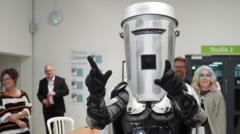
Conventional political commentary treats the ballot box like a cathedral. When a satirist wearing a kitchen utensil on his head pulls nearly twenty-seven percent of the vote in a parliamentary contest, the mainstream media treats it as a quirky British anomaly. A cheeky protest. A harmless bit of pantomime where disgruntled citizens tick a joke option because they are bored.
This is a comfortable delusion.
The lazy consensus around novelty candidates assumes that people who vote for an intergalactic space warrior with a waste-management fetish are throwing their votes away out of sheer nihilism. They are dismissed as unserious people making an unserious point. But if you look at the mechanics of voter behavior in modern contested districts, a much sharper, more uncomfortable reality emerges. Those votes are not wasted. They are a precise, calculated act of political demolition.
The Boycott Trap and the Anatomy of a Proxy War
Take the Clacton by-election. Mainstream powerhouses like Labour, the Conservatives, and the Liberal Democrats tucked tail and refused to field candidates, running away from a messy fight. By abandoning the field, the major parties tried to delegitimize the entire exercise. They expected voter turnout to crater into irrelevance, leaving a coronation for Reform UK leader Nigel Farage.
Instead, nearly ten thousand voters turned up and handed a trashcan-helmeted comedian second place.
Mainstream analysts frame this as a quirky rejection of the frontrunner. That misses the structural target entirely. When major parties surrender a constituency, they leave a vacuum. Voters who refuse to bend the knee to populism or accept default victories need a vehicle. A satirical candidate ceases to be a joke the moment they become the only viable vessel left standing against an uncontested coronation.
To call these voters unengaged is elite projection. They are hyper-engaged. They read the ballot, noticed every major establishment party had fled the battlefield like cowards, and deliberately weaponized absurdity to puncture a rigged environment.
The Weaponization of Ridicule
Democracy dies not just in darkness, but in dull, procedural self-seriousness. For decades, political operatives have relied on brand loyalty. They assumed voters would line up behind red, blue, or yellow badges out of tribal habit.
When citizens vote for a candidate whose platform includes capping the price of a passport photo and making Adele illegal, they are performing a high-frequency rejection of the institutional framework itself. They are saying that the regular options have become so intellectually bankrupt that a fictional alien from the Sigma star system offers a more honest representation of their frustration.
Consider the data from previous outings. When the exact same satirical persona challenged mainstream figures like Andy Burnham in local contests, he pulled a microscopic ninety-five votes. Why? Because actual political competition existed. Voters had real alternatives, so the satirical vote remained a tiny statistical noise.
Fast forward to a contest stripped of mainstream rivals, where a populist juggernaut tries to claim a mandate by default. The spike to over nine thousand votes is not random noise. It is an organized redirection of fury. It represents an electorate calculating the exact mathematical weight of their cross on the paper to cause maximum aesthetic embarrassment to the political class.
The Comforting Lie of Voter Apathy
Establishment pundits love the phrase "voter apathy" because it absolves them of responsibility. If citizens stay home or vote for a joke, it is because those citizens are too lazy or uninformed to grasp complex policy.
The opposite is true. Voting for a satirical candidate takes deliberate effort. You have to look past the institutional pressure, ignore the solemn warnings of serious analysts, and manually write or select a protest option that you know will dominate the morning headlines as a humiliating footnote for the victors. It requires more conscious intent than ticking a party box out of hereditary habit.
Imagine a corporate market where ninety percent of the customer base walks away in disgust, and the remaining active buyers purchase novelty gag items in massive quantities just to mock the corporate board. The executives would not call those buyers confused. They would recognize an existential crisis of brand trust. Yet in politics, analysts look at the exact same phenomenon and call it a quaint local custom.
The truth is stark. The people who backed the metallic headgear did not misunderstand democracy. They understood it better than the professionals running it. They realized that when the system turns into a farce, treating it with solemn dignity is the ultimate form of collaboration.
Stop patronizing the electorate. They knew the helmet was plastic. They just wanted to see if the establishment's skin was equally thin.