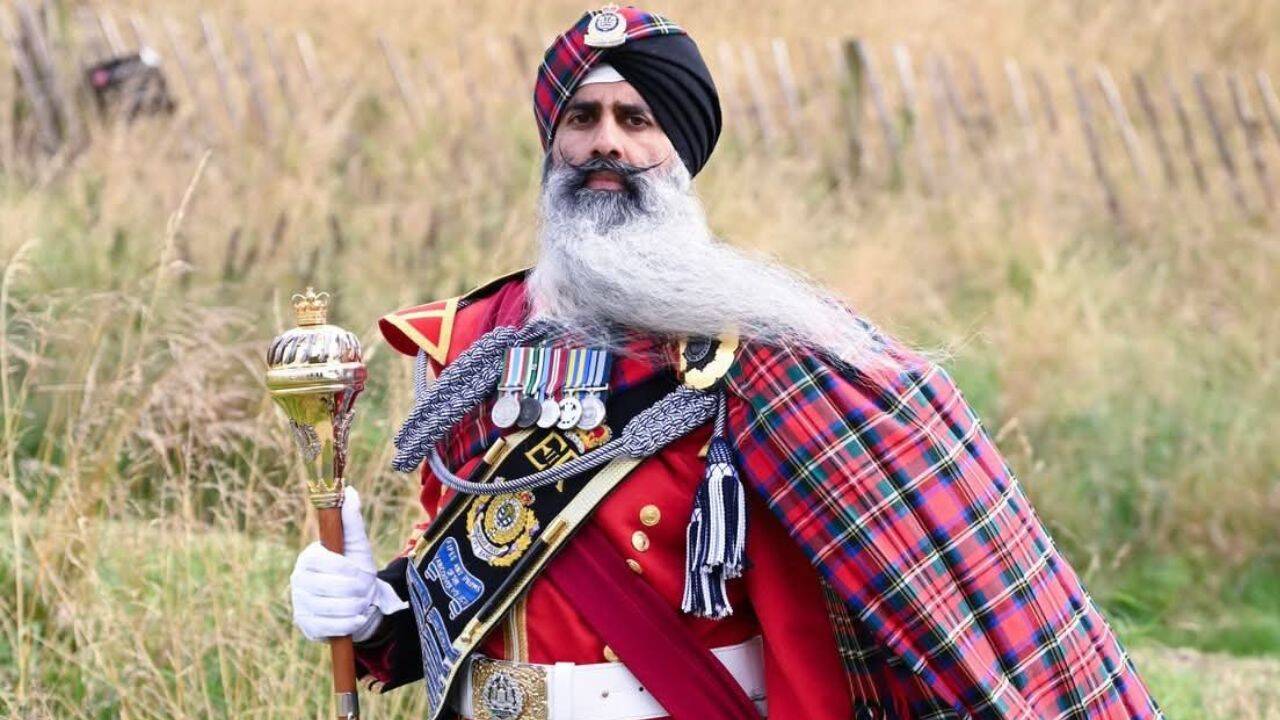
Institutional longevity relies on the simultaneous preservation of core operational codes and the tactical adaptation of visible symbols. When Constable Sukhvinder Suki Singh Sunger stepped onto the Edinburgh Castle Esplanade as the Drum Major for the Vancouver Police Pipe Band at the 2026 Royal Edinburgh Military Tattoo, the event was evaluated by casual observers as a mere milestone in visual diversity. A deeper examination reveals a precise operational convergence between traditional Scottish military pageantry and modern civic institutional frameworks.
The appearance of a turbaned Sikh officer wearing a Royal Stewart tartan kilt paired with a ceremonial dastaar instead of a conventional feather bonnet requires an analytical breakdown of how century-old organizations absorb demographic shifts without compromising structural integrity.
The Anatomy of Institutional Continuity
The Vancouver Police Pipe Band, established in 1914, operates under rigid historical parameters. Pipe bands function as closed feedback loops where musical execution, drill precision, and uniform codes are maintained through generational transmission. Introducing a non-traditional element into such a system usually creates friction unless the integration follows a strict functional pathway.
Sunger’s trajectory within the organization illustrates a calculated progression from peripheral participation to central command:
- Phase One: Entry via functional utility. Joining the unit around 2018 to 2019 as a tenor drummer and subsequently introducing the Punjabi dhol, which expanded the band's acoustic range during international tours such as the 2019 Punjab engagements.
- Phase Two: Merit-based internal election. Securing the role of Drum Major in December 2025 for a three-year term through peer evaluation rather than external mandate.
- Phase Three: Symbolic execution on a global stage. Leading the formation at the 2026 Tattoo production themed "A Call to Gather".
This progression demonstrates that institutional acceptance is conditional upon operational competence. The uniform adaptation—substituting the feather bonnet for a specially designed ceremonial dastaar matching the tartan—serves as a case study in modular uniform design. The visual syntax of the pipe band remains intact while accommodating an immutable article of faith.
The Cost Function of Cultural Synchronization in Public Service
Public safety agencies face a continuous optimization problem: maintaining high-trust community engagement while executing standardized enforcement mandates. Sunger’s professional background—spanning over two decades as a traffic enforcement officer with the Vancouver Police Department, a reserve stint with Victoria Police, and a United Nations peacekeeping deployment in South Sudan—highlights the operational crossover required for modern policing.
The mechanism connecting international peacekeeping with ceremonial leadership is institutional legibility. Agencies that deploy personnel into complex geopolitical environments or multicultural urban centers require operatives who can bridge disparate behavioral norms. When a uniformed officer occupies a prominent international cultural space, the organization projects adaptability. This reduces the institutional friction often observed between insular municipal agencies and diverse local populations.
The integration of the dastaar with Highland dress acts as a stress test for institutional rigidity. Organizations that fail to adapt their uniform policies face recruitment bottlenecks among minority demographics. Conversely, organizations that establish clear parameters for uniform modification—maintaining color coordination and ceremonial discipline—lower barriers to entry while preserving unit cohesion.
Systemic Ripple Effects Across International Lineages
The intersection of Scottish military music and Sikh heritage is not entirely unprecedented—historical military ties between British regiments and Sikh forces date back to the 19th century—but its manifestation in a civilian municipal police band on an international stage alters the calculus of cultural representation.
When analyzing the downstream effects of Sunger’s appointment, three distinct systemic shifts emerge:
- Protocol Evolution: Ceremonial guidelines across international pipe bands are forced to codify uniform exemptions that respect articles of faith without destabilizing visual uniformity.
- Global Brand Equity: Civic units like the Vancouver Police Pipe Band enhance their international marketability by visibly embodying contemporary multicultural competencies.
- Generational Signaling: Visible leadership positions occupied by minority personnel within traditionalist frameworks accelerate recruitment velocity among demographic groups previously alienated by rigid historical aesthetics.
The performance at Edinburgh Castle proved that heritage institutions do not need to dilute their core practices to remain relevant. Instead, they can expand their design parameters.
Execute the next organizational phase by auditing existing uniform and ceremonial codes to identify unnecessary structural barriers, replacing arbitrary traditionalism with functional standards that preserve core discipline while accommodating verified operational identities.


.png?width=1200&auto=webp&trim=0%2C0%2C0%2C0)