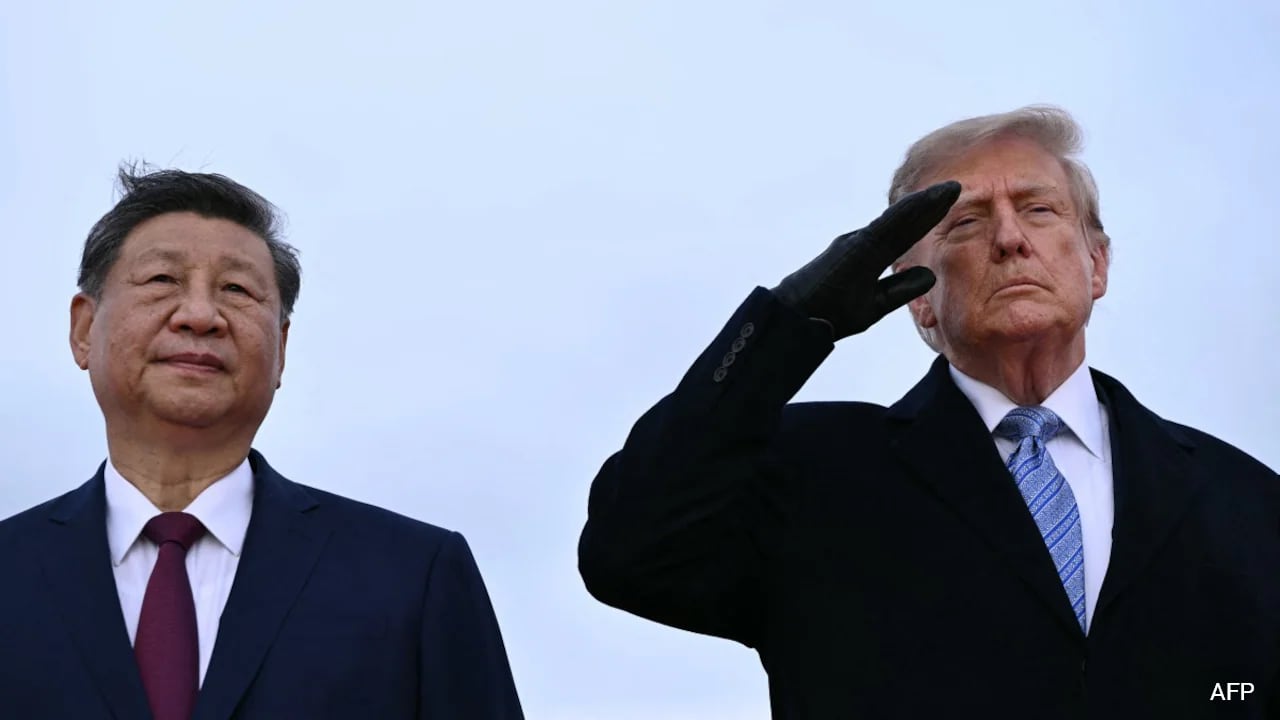
Every major newsroom is currently treating a presidential handshake like a macroeconomic crystal ball. The narrative is almost painfully predictable. Two superpowers lock horns, media outlets track every millimeter of a red carpet rollout, pundits hyperventilate over tariff exemptions, and retail investors completely panic over whether a communique signals de-escalation or a cold war sequel.
It is absolute theater. And falling for it is a magnificent way to torch your returns. Read more on a related issue: this related article.
The lazy consensus in international relations reporting is that political summits dictate market outcomes. If Xi Jinping and Donald Trump share a warm handshake and a staged smile over a state dinner, stocks rally because people convince themselves that global trade friction is vanishing. If they glare at each other across a mahogany table, algorithmic panic hits the terminals.
I have watched institutional desks blow hundreds of millions of dollars trying to trade the rhetoric of these bilateral summits. The reality on the ground is starkly different. Global supply chains do not care about protocol photoshoots. Capital allocation models do not rewrite themselves because two leaders agreed to establish a working group on rare earth minerals. Structural decoupling is not a toggle switch that turns off when a red carpet gets rolled out. More analysis by Al Jazeera delves into related views on this issue.
Let us dismantle the core falsehoods driving the current media frenzy.
The Geopolitical Distraction Fallacy
The primary delusion is that a state visit represents a turning point in bilateral friction. It does not. It represents a pause button, pressed purely for domestic optics.
When political leaders sit down for high-profile talks, they are playing to two distinct audiences: domestic voters who want to see strength and corporate lobbyists who want predictable cash flows. Neither goal requires a structural resolution to deep-seated technological competition.
Consider the semiconductor restrictions, export controls, and capital screening mechanisms implemented over the past several years. These are not arbitrary whims of an administration that a summit can negotiate away. They are bipartisan, institutional, and baked into national security strategy. Bureaucratic momentum in Washington and Beijing vastly outlasts the political tenure of any single president or premier.
When a commentator claims a summit will reset trade relations, they are confusing diplomacy with economics. Trade is no longer driven by diplomatic goodwill. It is driven by national security mandates, sovereign data protection, and industrial self-reliance. You cannot negotiate away a structural technological race with a pleasant lunch.
Where the Consensus Misses the Mark
The conventional analysis always focuses on the surface-level metrics. Total trade volume, bilateral tariff rates, and diplomatic communiques dominate the headlines. This is economic illiteracy disguised as sophistication.
Focusing on aggregate trade numbers misses the hyper-specific fragmentation happening underneath. Globalization as a uniform, frictionless network is dead. In its place, we have balkanized trade blocs, friend-shoring corridors, and parallel technology stacks.
If you are positioning your capital based on whether the US and China sign a memorandum of understanding on agricultural purchases, you are staring at the rear-view mirror. The actual movement of money is ignoring the political noise entirely. Capital is flowing toward redundancy, supply chain duplication, and localized manufacturing resilience.
Companies that survive this era are not the ones waiting for a tariff waiver. They are the ones spending heavily to build duplicate supply chains in Vietnam, Mexico, and India. They understand that the old world of hyper-optimized, single-source manufacturing out of Shenzhen is gone forever, regardless of how many times a head of state smiles for the cameras.
The Cost of Political Theater
Let us look at the downside of my own contrarian approach. Dismissing political summits as theater can cause you to miss short-term, sentiment-driven volatility spikes.
Algorithmic trading desks live for these headlines. A single sentence uttered during a press conference can trigger a three percent intraday swing in export-heavy equities. If you are a short-term momentum trader, ignoring the summit is professional suicide.
However, if you are building a portfolio with a multi-year horizon, reacting to this intraday turbulence is a tax on your intelligence. Chasing sentiment spikes created by diplomatic pageantry guarantees you will buy high on optimism and sell low on the inevitable reality check that follows every summit.
The structural forces shaping global commerce are slow-moving tectonic plates. A state visit is just surface spray.
How to Position Your Capital Now
Stop trying to handicap geopolitical negotiations. You do not have insider intelligence from Zhongnanhai or the West Wing, and even the people who think they do are usually wrong.
Instead, look at the cold, hard metrics of industrial adaptation.
First, audit your holdings for jurisdictional vulnerability. If a company relies entirely on a single manufacturing hub for its critical inputs, it is a ticking time bomb—no matter what trade agreements get signed this week.
Second, overweight businesses that monetize sovereign security and infrastructure independence. Industrial automation, domestic logistics, cyber defense, and near-shored manufacturing capacity are winning structural secular tailwinds. They do not depend on bilateral harmony. They thrive on friction because geopolitical tension forces governments and enterprises to spend aggressively on resilience.
The next time you see breaking news about a high-stakes presidential arrival, close your browser, ignore the talking heads, and look at your balance sheet instead. Real value is built in the factories, codebases, and logistics networks, never on the red carpet.