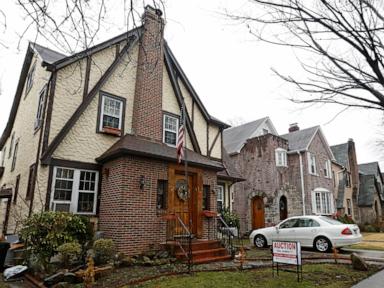
Asset valuation anomalies tied to high-profile political provenance rarely adhere to traditional market fundamentals. When a residential property transitions from a neglected, distressed physical state to a modernized luxury listing backed by historical political association, it provides a empirical case study in real estate pricing elasticity. The recent transaction of the Jamaica Estates property in Queens—built originally in 1940 by Fred Trump and later serving as the early childhood residence of Donald Trump—commands a detailed examination of how capital expenditure, historical friction, and brand association interact to drive a $1.93 million acquisition price.
The Capital Expenditure and Distress Recovery Vector
The trajectory of the Queens property prior to its final transaction illustrates the economics of distressed asset recovery. Acquired previously for $835,000 in a structurally compromised state—characterized by severe water damage, plumbing failures, and deferred maintenance—the property functioned as a negative-cash-flow liability.
To bridge the gap between distressed valuation and market liquidity, a capital expenditure strategy must address three distinct variables:
- Structural Remediation: Eradicating deep-seated moisture degradation, mold colonization, and compromised infrastructural systems that present catastrophic risks to potential buyers.
- Aesthetic Realignment: Modernizing interior layouts while retaining the exterior Tudor-style architectural integrity mandated by the neighborhood's historical profile.
- Carrying Cost Minimization: Executing the renovation timeline rapidly to reduce the accumulation of property taxes, insurance premiums, and debt service costs.
The transformation of the asset from a neglected physical state to a market-ready luxury home required substantial capital deployment. Subtracting the initial acquisition cost of $835,000 from the final sale price of $1.93 million yields a nominal gross margin of approximately $1.095 million before accounting for construction overhead, holding expenses, and transaction fees. This spread demonstrates that the value captured was not merely a function of broad macroeconomic appreciation in the outer-borough New York real estate market, but a direct consequence of forced value-add development.
The Provenance Premium and Market Liquidity
Real estate assets linked to figures of intense historical or political prominence occupy a bifurcated market. Unlike standard commercial or residential comparables, these properties derive a portion of their perceived worth from intangible historical provenance. However, quantifying this premium requires separating notoriety from structural utility.
In the case of presidential childhood homes, the target buyer pool splits into two distinct segments: institutional speculators or private collectors motivated by political symbolism, and conventional buyers seeking high-end suburban square footage within commuting distance of Manhattan.
When an asset carries polarizing or intensely debated political associations, traditional pricing metrics face downward pressure from buyers who wish to avoid public scrutiny, security overhead, or neighborhood disruption. Conversely, speculative buyers often overpay under the hypothesis that historical provenance guarantees future liquidity. The final transaction price of under $2 million reflects a ceiling imposed by the micro-market of Jamaica Estates, Queens, proving that hyper-local neighborhood comparables ultimately anchor valuation regardless of national celebrity status. Historical association accelerates market visibility and attracts transactional liquidity, but it cannot permanently detach a suburban residential asset from the underlying income and demographic constraints of its zip code.
The Operational Mechanics of Asset Transformation
Executing a high-margin flip on a politically sensitive property requires navigating unique operational bottlenecks that do not exist in standard residential development.
The primary operational constraint involves zoning and historic district compliance. Properties located in established residential enclaves often face strict architectural oversight. Upgrading structural components while preserving exterior facades demands specialized engineering solutions and prolonged municipal approval cycles. Any delay in these approvals expands the holding period, directly eroding the net profit margin of the developer.
A secondary constraint is security and public disruption during the renovation and marketing phases. Properties associated with major political figures attract uninvited public foot traffic, media scrutiny, and demonstrations. This external friction complicates contractor retention, drives up insurance costs, and deters risk-averse retail buyers during open-house events.
To maximize net realization on properties burdened by high public interest, developers must execute a strict confidentiality protocol during the acquisition and renovation phases, releasing the asset to the open market only after physical restoration is entirely complete. This eliminates speculative volatility and forces the market to evaluate the property on its structural merits rather than its political baggage.
Strategic Asset Allocation and Portfolio Forecast
Future transactions involving residential properties tied to polarizing political figures will continue to exhibit high volatility and compressed buyer pools. Investors evaluating similar acquisition targets must prioritize rigorous risk-adjusted return calculations over speculative historical narratives. The structural upside of an asset is determined by square footage, school districts, and infrastructural quality—variables that remain immutable long after the political headlines fade. Capital deployed into distressed historical real estate must be justified by hard renovation metrics, ensuring that the asset commands structural utility even if the provenance premium fails to materialize at exit.