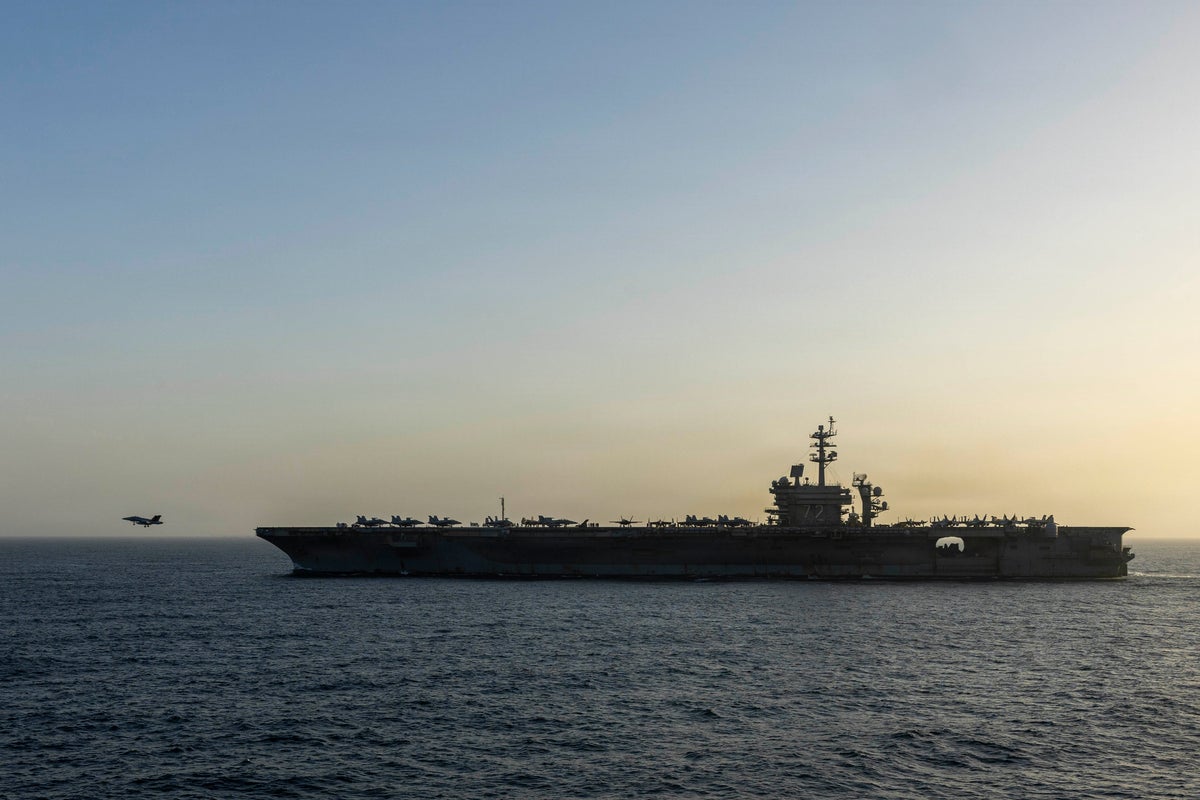
United States military forces struck Iranian rocket launchers on Larak Island within the Strait of Hormuz, shattering a month-long operational lull and laying bare the fragile reality of Washington’s containment strategy. Central Command confirmed that Islamic Revolutionary Guard Corps units were actively rigging rockets with naval mines intended for dispersal across critical global shipping lanes. This kinetic intervention marks the first direct American strike inside the theater since late July, abruptly puncturing the White House's recent pivot toward economic coercion and secondary financial sanctions.
For six months, the naval blockade enforced by American warships has sought to starve Tehran of maritime trade while keeping the vital energy corridor open. Yet, the underlying math of the conflict remains stubborn. As long as the Iranian Revolutionary Guard retains asymmetric capabilities along the shallow coastlines and islands of the Persian Gulf, global commerce moves at the mercy of hidden launchers and improvised ordnance.
The Geography of Asymmetric Coercion
The Strait of Hormuz is narrow. At its tightest point, the shipping channel narrows to just two miles wide for inbound and outbound traffic, flanked by Iranian-controlled islands that offer natural redoubts for mobile artillery and small boat swarms.
Controlling this bottleneck does not require a blue-water navy. It requires patience, concrete bunkers, and inexpensive contact mines.
When American minesweepers finished clearing lingering ordnance from international channels last week, military planners knew the clearance was temporary. Larak Island sits uncomfortably close to those exact shipping lanes. By positioning rocket-assisted mine deployment systems on the island, Tehran bypasses the need for traditional minelaying vessels, which are easily tracked by overhead assets and naval radar.
Instead, a truck-mounted launcher hidden beneath a net can fling a cluster of sea mines directly into a transit lane within minutes. The United States response had to be instantaneous precisely because the window between deployment and commercial disaster is measured in seconds.
The Logistics Wall and Military Fatigue
Behind the high-definition briefings in Washington lies a grinding logistical reality that active-duty commanders discuss only in private. The operational tempo demanded by months of continuous deployments in the Middle East has strained military readiness to a dangerous degree.
Senior service chiefs recently warned defense leadership that maintaining thousands of troops, multiple carrier strike groups, and sustained aviation packages in the region is fundamentally unsustainable over the long term. Specialized units, including elements of the elite airborne divisions mobilized early in the crisis, face tour extensions that weigh heavily on retention and force health.
Munitions stockpiles tell a similar story. Intercepting drones, anti-ship missiles, and clearing commercial paths requires high-end guided weaponry that is expensive to replace. Every time an American warship fires a precision missile to destroy a rudimentary launcher on Larak Island, a fiscal and strategic gap widens between current expenditures and long-term defense priorities elsewhere in the world.
Economic Warfare Versus Kinetic Reality
The White House attempted to shift the center of gravity away from military strikes by leaning heavily on Treasury-led financial measures. Treasury Secretary Scott Bessent rolled out aggressive secondary sanctions designed to penalize foreign financial institutions and trading partners that continue doing business with Tehran.
Yet, these economic levers walk a perilous tightrope. Push too hard on international banking networks, and the resulting shockwaves threaten global market stability. Pull back too soon, and the Iranian regime absorbs the blow while continuing to fund its regional proxies.
Energy markets instantly registered the friction of Sunday's strike, with crude benchmarks ticking upward as traders recalculated the risk premium attached to every barrel transiting the Persian Gulf. The market understands a fundamental truth that political speeches gloss over: economic sanctions do not sink floating mines, and financial penalties do not stop a rocket from leaving a rail on Larak Island.
Tehran’s state media has already vowed severe retaliation, claiming the latest American action resulted in casualties among its personnel and promising a direct response. Whether that retaliation manifests as another drone strike against regional allies, renewed harassment of commercial tankers, or further asymmetric maneuvering in the gulf, the cycle remains unbroken.
The illusion of a clean, distant economic blockade has vanished beneath the smoke of burning rocket rails on the Hormuz coastline, leaving American forces tethered to an endless watch over one of the most volatile stretches of water on earth