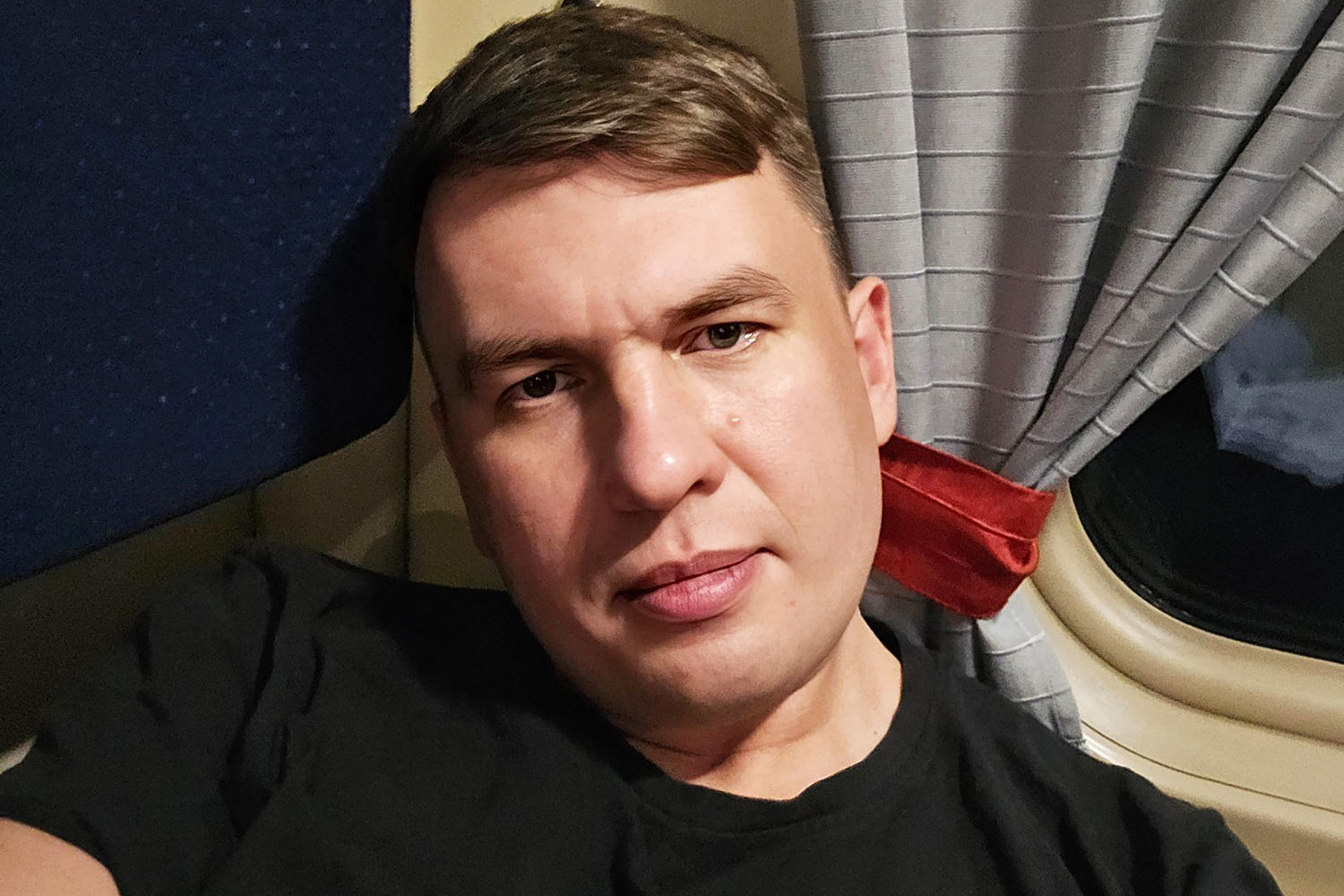
The train from St. Petersburg to Moscow moves with a heavy, predictable rhythm. Iron wheels hit iron rails. Outside the window, the Russian birch forests blur into a gray smear under the summer sky. Inside one of the compartments sits a forty-two-year-old lawyer. He is not traveling by choice. Handcuffs constrain his wrists. Armed guards watch his every breath.
His name is Ilya Remeslo.
A few months ago, his face was a fixture on state-aligned digital feeds, his legal briefs weaponized to tear down anyone who dared question the state. Today, he is the prey. The very machinery he helped build, calibrate, and sharpen has turned its teeth toward him.
To understand how a man goes from the inner sanctuary of an authoritarian media empire to a steel-bound transport carriage, you have to look past the official press releases. You have to look at the slow, quiet rot of a conscience that suddenly decides to scream.
The Mechanic of the Machine
For years, Remeslo knew exactly how the system operated. He was a lawyer by trade, but his real work was architecture. He built legal cages. When the late opposition leader Alexei Navalny exposed state corruption, it was Remeslo who filed the meticulously drafted complaints. He dug through financial records, drafted petitions to the censor, and appeared in courtrooms to provide a veneer of legality to political executions.
He was an attack dog. A highly effective one.
Imagine sitting in a warm Moscow office, watching a screen, knowing that a single keystroke from your hand can trigger a raid on an activist’s home. It is a intoxicating form of power. It creates a sense of safety. You believe that because you are holding the leash, you can never be the one in the collar.
Remeslo’s Telegram channel grew to nearly one hundred thousand followers. In the ecosystem of the Russian internet, he was a pillar of the "Z-community"—the digital vanguard cheering on the invasion of Ukraine. He wrote posts justifying the missile strikes. He defended the grinding, bloody frontline advances. He was part of the choir, singing the praises of Vladimir Putin’s grand historical destiny.
Then, the script broke.
The shift did not happen overnight. Conscience is rarely a sudden lightning bolt; it is a rising tide. Think of a man who spends years ignoring a crack in his own living room wall until the day the ceiling begins to sag. Remeslo was watching the same war data as everyone else. He saw the tiny, insignificant villages bought with thousands of young Russian lives. He watched the economy warp under international sanctions. He saw the internet he loved being systematically dismantled, blocked, and choked by the state.
He knew the truth. More importantly, he knew that the people around him knew it too.
The Manifesto
On a Tuesday night in mid-March, Remeslo did something unthinkable. He opened his laptop, tapped into his Telegram channel, and uploaded a post titled "Five reasons why I stopped supporting Vladimir Putin."
It was not a mild critique. It was an execution of his own past.
He called the war in Ukraine a failing, dead-end conflict. He pointed out the massive, hidden casualties. He looked at the twenty-four years of Putin’s rule and wrote that absolute power corrupts absolutely. Then came the words that guaranteed his ruin: he called the president an illegitimate leader, a thief, and a war criminal who needed to stand trial.
The Russian digital space went cold.
The immediate reaction from his former allies was disbelief. A hack, they whispered. It had to be a Ukrainian cyberattack. But hours later, Remeslo uploaded a video. It was his face. It was his voice. He looked tired, but his eyes were steady. He confirmed every word. He told his audience that he was still in Russia, that he was not running away, and that he was ready for whatever came next.
Consider what happens when a defector leaves the ranks of the enemy. It is a propaganda victory. But when a priest inside the temple turns around, smashes the altar, and calls the god a fraud, the system cannot merely punish him. It must erase his sanity.
The day after his video went live, Remeslo vanished.
He did not go to a prison. Not yet. Instead, he was taken to St. Petersburg’s Psychiatric Hospital No. 3.
The Soviet Ghost
Medical isolation is an old, dark ghost in Russian history. During the Soviet era, dissidents were routinely diagnosed with "sluggish schizophrenia." The logic was simple: only a crazy person would oppose the paradise of the state. By placing Remeslo in a psychiatric ward, the system attempted to strip away his martyrdom. He wasn't a brave rebel; he was just an unstable man having a nervous breakdown.
Propagandists on state television quickly adopted the narrative. They spoke of him with mock pity. They suggested the stress of the war had broken his mind.
Inside the clinic, the silence was total. His phone was confiscated. His lawyers were kept at bay. For a month, he existed in a white room, a legal ghost in a country he had helped strip of legal protections.
Yet, he refused to recant. When he was finally released from the facility, he told those close to him that the hospitalization was involuntary, a direct act of psychological retaliation. He had seen the inside of the machine from both sides now—as its operator, and as its fuel.
He stayed in his apartment. He waited for the other shoe to drop.
The Long Journey to Moscow
The reprieve ended on a Friday morning in July. The state does not forget, and it rarely forgives a traitor from within its own ranks.
Agents arrived at his door in St. Petersburg. The official charge was the now-standard cudgel used to beat down any lingering independent thought: spreading false information about the Russian military. It is a charge that carries a ten-year prison sentence.
The law he is accused of breaking is a law he once cheered for.
Now, he is in transit. The journey from St. Petersburg to a Moscow courtroom is a well-traveled path for dissidents. It is designed to exhaust the spirit. It isolates the accused from their support network, moving them through a network of holding cells and transit prisons until they are thoroughly disoriented.
The true tragedy of Ilya Remeslo is that he has no home left. To the Russian opposition, the people who marched with Navalny and spent years in exile or behind bars, Remeslo remains a villain. They remember his old articles. They remember the lives he helped ruin. To them, his sudden conversion is either too late, or a calculated gamble that went terribly wrong.
To the Kremlin loyalists, he is the ultimate Judas. He is a man who ate from the state’s hand and then tried to bite it off.
He sits between two worlds, completely alone, riding a train toward a decade in a penal colony.
The system relies on a collective agreement to pretend. It requires thousands of lawyers, journalists, and officials to look at a disaster and call it a victory. It requires men like Remeslo to keep writing the script long after the scenery has caught fire. But once an insider decides to stop pretending, the illusion cracks.
The train moves forward. The birch trees pass. In a courtroom in Moscow, a judge is already preparing the paperwork for a sentence that was decided weeks ago.