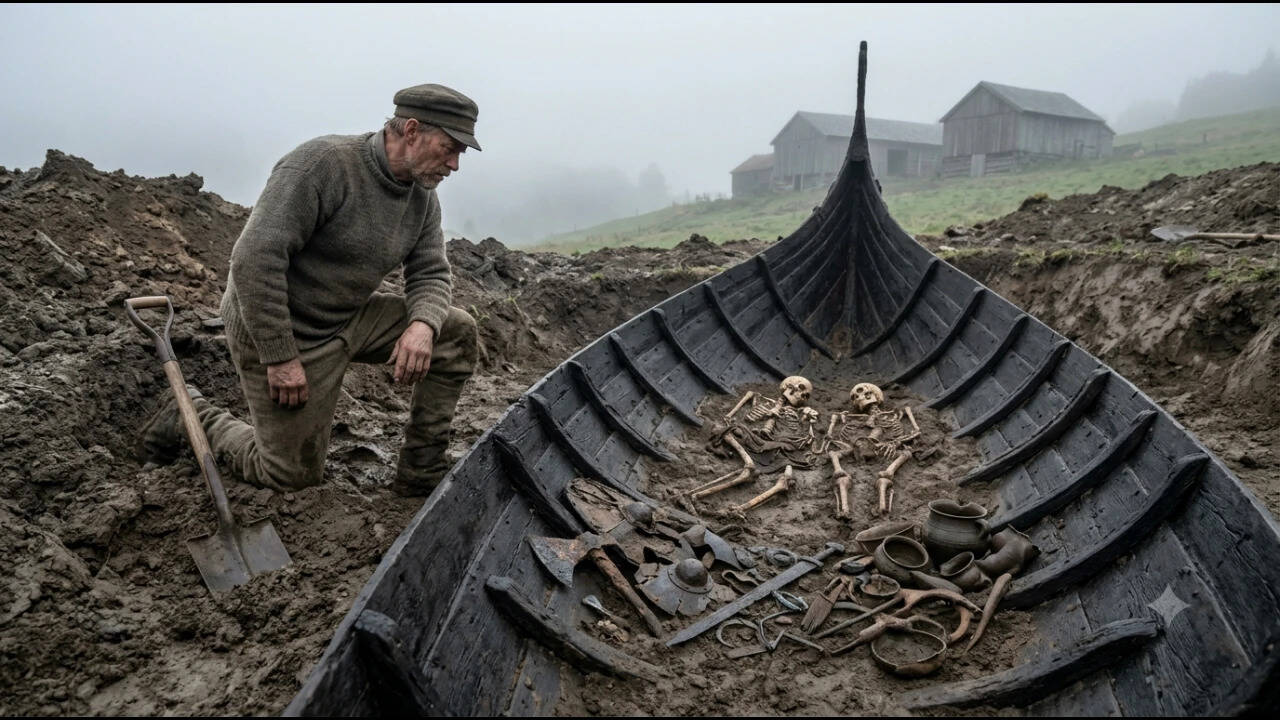
Analyzing elite Scandinavian maritime interments requires moving past romanticized narratives of warrior culture to examine the quantifiable socioeconomic inputs required for such monuments. When historical records or modern discoveries highlight agrarian landowners uncovering ship burials such as the famous Oseberg find—where a vessel contained the skeletal remains of two high-status women—the event represents a compressed archive of ninth-century capital deployment. This analysis deconstructs the structural economics, material sourcing friction, and sociopolitical signaling embedded within elite maritime mortuary practices.
The Economic Cost Function of Maritime Interments
Constructing a ship burial demands an extraordinary expenditure of resources, labor, and capital assets. A standard Scandinavian longship or karve required thousands of man-hours from specialized craftsmen, spanning timber harvesting, plank riveting, and cordage production. When a community dedicated a functioning or purpose-built vessel to a burial mound, they permanently removed a high-value logistics and military asset from active circulation.
The resource allocation formula can be broken down into three primary variables:
- Material Opportunity Cost: The diversion of old-growth oak or pine from structural housing or seaworthy fleets to a static subterranean chamber.
- Labor Input: The synchronized coordination of blacksmiths, shipwrights, and general earthmovers over a multi-month period.
- Liquid Wealth Immobilization: The inclusion of grave goods, textiles, draft animals, and imported luxury items that were deliberately destroyed or sealed away.
This total capital write-off signals a profound sociopolitical calculation. Surviving members of the ruling household absorbed a massive short-term economic deficit to secure a long-term ideological monopoly. By converting portable wealth into immobile architecture, the surviving elite established an unassailable claim to ancestral territory and hereditary authority.
Gender, Status, and Power Hierarchies
Popular assumptions frequently misattribute elite ship graves exclusively to male warlords. However, prominent discoveries, most notably the Oseberg mound, document dual-female interments accompanied by extraordinary material wealth. Evaluating these sites necessitates a shift from military-centric paradigms to models of administrative and religious hegemony.
In early medieval Scandinavian society, political stability relied heavily on internal resource redistribution, ritual authority, and the management of domestic production networks. The inclusion of two women of high social standing—one elderly, one younger—points toward institutionalized roles running parallel to or intersecting with secular chieftains.
The structural indicators of their authority manifest through specific material correlates:
- Agricultural and Domestic Monopoly: The presence of extensive textile-making equipment, kitchen implements, and ornate carts indicates control over household production scales that dwarfed standard farmsteads.
- Sacral Leadership: Grave goods frequently feature ritual paraphernalia, suggesting these individuals held sacerdotal functions that legitimized the clan's spiritual and territorial mandate.
- Network Maintenance: Isotopic and stylistic analyses of grave goods often reveal foreign provenance, indicating that these women sat at the nexus of regional and international trade alliances.
The joint burial structure implies a succession mechanism or a shared governance model where power was concentrated within elite female lineages, or where the death of a primary matriarch necessitated the immediate structural reinforcement of her successor through simultaneous interment.
Environmental Degradation and Preservation Biomechanics
The physical survival of organic artifacts across a millennium depends entirely on localized chemical and hydrological parameters. The discovery of ships and wooden structures by farmers expanding arable land or archaeologists utilizing ground-penetrating radar highlights a narrow window of preservation mechanics.
Unoxygenated, alkaline-stable clay environments prevent aerobic bacterial decomposition of timber, but changing agricultural drainage patterns systematically disrupt these subterranean equilibria. Modern farming introduces mechanical stress via deep plowing and accelerates oxygen diffusion through the soil matrix, initiating rapid fungal decay of buried wooden hulls.
Understanding this degradation vector requires evaluating the interaction between soil acidity, water table fluctuations, and iron oxidation rates from ship rivets. When topsoil is disturbed above a burial mound, the microclimate shifts, stripping the chemical armor that protected organic matrices for centuries.
Strategic Resource Allocation for Preservation
Preserving these subterranean archives demands an operational framework balancing minimal site disturbance against maximum data recovery.
- Non-Invasive Diagnostics: Prioritize electromagnetic conductivity mapping and ground-penetrating radar to profile internal structures without breaching the chemical seal of the mound.
- In-Situ Stabilization: When excavation is economically or logistically prohibitive, implement water table management and chemical grouting to freeze the decay process underground.
- Controlled Excavation: If structural integrity is actively threatened by agricultural encroachment or erosion, execute a phased block-lift protocol to transport saturated wooden elements to climate-controlled conservation facilities immediately.
The recurring exposure of monumental ship graves by agrarian laborers underscores the persistent intersection of modern land use and deep history. Treating these sites not merely as curiosities, but as capital-intensive monuments of structural power, allows analysts to reconstruct the precise economic architecture of the early medieval North.